

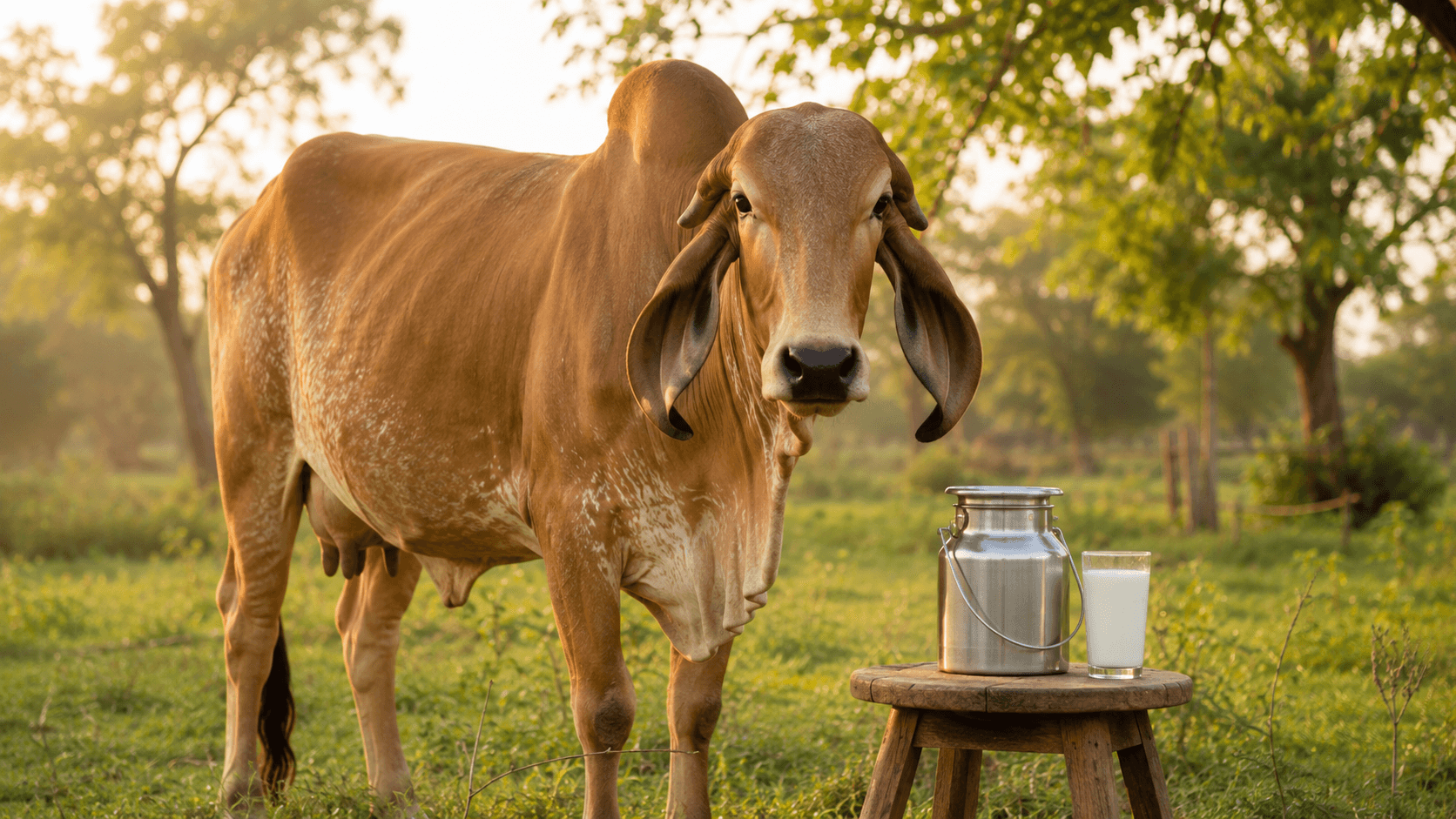
A2 vs A1 Milk: What the Protein Difference Really Means
The jar says A2. The price is close to double. Somewhere on the label there is a line about ancient desi breeds, and nothing at all that tells you what A2 is. So here it is without the marketing. A1 and A2 differ by one amino acid in one protein . That is the entire difference. What follows from it is more interesting, and it is also where most brands quietly overstate their case.
The Quick Answer
A1 and A2 are two variants of beta-casein, one of the main proteins in milk. They differ at a single position in the protein chain: A1 carries histidine there, A2 carries proline. That one swap changes how the protein breaks apart during digestion, and A1 can release a fragment called beta-casomorphin-7, or BCM-7. Indigenous Indian cattle are predominantly A2A2. Many high-yield European and crossbred cows carry A1. Now the part the labels leave out. The human health evidence around A1 is limited and still argued over , and in ghee most of the protein is removed during processing anyway. A2 does tell you something worth paying for. Just not the thing the label implies.
A1 vs A2, Side by Side
| Factor | A1 beta-casein | A2 beta-casein |
|---|---|---|
| Amino acid at position 67 | Histidine | Proline |
| Typical source | Holstein, Friesian and many Indian crossbreds | Gir, Sahiwal, Red Sindhi, Tharparkar, Rathi. Buffalo milk too. |
| During digestion | The chain can split and release BCM-7 | Proline holds the chain together, so BCM-7 release is minimal |
| Reported comfort | Some people report bloating or heaviness | Often reported as lighter and easier |
| Evidence status | Limited, mixed, actively debated | Same. Nothing here is settled science. |
| Lactose content | Identical | Identical. A2 is not lactose-free. |
| Milk yield per cow | High | Considerably lower |
| Price in India | Standard | Premium, frequently double |
Beta-Casein, in Plain Terms
Around 80% of the protein in cow milk is casein, and beta-casein is the largest share of that. It is a chain of 209 amino acids. At position 67 in that chain, a cow carries either histidine, which gives you the A1 version, or proline, which gives you A2.
Proline binds tightly to its neighbour. Histidine does not. So when digestive enzymes go to work, the A1 chain can break at that weak point and release BCM-7, a short peptide with opioid-like activity in laboratory conditions. The A2 chain tends to hold together.
Every cow carries two copies of the gene, one from each parent, so a cow can be A1A1, A1A2 or A2A2. Only an A2A2 cow gives milk with no A1 beta-casein in it at all. That is why serious A2 dairies genotype-test their herds instead of assuming that breed alone settles it.
Which Indian Breeds Give A2 Milk
India's advantage here is genetic and largely accidental. Our indigenous cattle were never bred for industrial yield, so they kept the A2 variant that high-output European breeds mostly lost.
- Gir from Gujarat, Sahiwal from the Punjab region, plus Red Sindhi , Tharparkar and Rathi are the best known. ICAR's National Bureau of Animal Genetic Resources maintains the registry of recognised indigenous breeds .
- Buffalo milk does not carry the A1 variant found in crossbred cows, which is why buffalo ghee sidesteps this debate completely.
- Now the catch. Decades of crossbreeding for yield, documented in NDDB's animal breeding programmes , introduced Holstein and Jersey genetics across large parts of Indian dairy. A cow that looks desi is not automatically A2A2.
So "desi cow" and "A2" are not interchangeable, even though packaging treats them that way.
What the Evidence Shows, and What It Does Not
Most A2 marketing rests on a body of research much shakier than the confidence of the claims built on top of it. The fair summary:
- BCM-7 formation from A1 beta-casein is well established in the lab . That part is not disputed.
- Whether it translates into meaningful health effects in people is not established . The published research is mostly small, short and mixed, and a number of the trials were industry-funded.
- Some studies report better digestive comfort on A2 milk. Others find no difference. Neither result is strong enough to close the question.
- Claims tying A1 milk to diabetes, heart disease or autism have not held up under serious review. A brand making them is unreliable on everything else too.
- Lactose intolerance is a separate problem. That involves the milk sugar, not the protein. Switching to A2 will not fix it, and a label implying otherwise is misleading you.
What survives is modest and real. For some people A2 milk sits more comfortably. Worth something, certainly. Not worth the sweeping language on most packaging.
Does A2 Even Matter in Ghee? The Part Nobody Explains
This is the section our competitors will not write, and you should know it before spending more.
Ghee is clarified butterfat. In the Bilona process, milk is set into curd, the curd is churned into makkhan, and the makkhan is simmered until the water evaporates and the milk solids separate out and are removed. Casein lives in those milk solids. By the time you have ghee, nearly all the beta-casein, A1 or A2 alike, has been taken out. It is the same reason pure ghee suits many people with mild dairy sensitivity.
Which makes the direct protein argument for A2 ghee weak. Anyone selling you A2 ghee on the strength of its protein has either not thought it through, or is counting on you not to.
So why does the milk source still matter? Because A2 works as a reliable proxy for everything else :
- An A2 herd means indigenous breeds, which means much lower yield per cow, which rules out industrial-scale dairy.
- Lower yield means smaller herds, and smaller herds tend to be grazed rather than raised on concentrate feed.
- Grazing shows up in the fat itself: more beta-carotene, which is the golden colour in cow ghee, a different fatty acid profile, and an aroma you cannot fake.
- Ghee is roughly 99% fat, so the fat is the entire product. Breed and feed are what shape it.
The honest case for paying more is the whole system behind the jar. Not one amino acid.
What Purity Standards Actually Cover
India's food safety regulations define what may legally be sold as ghee and what the label must declare. They do not certify A2 status. There is no mandatory A2 testing regime, which means the word on a jar is worth exactly as much as the dairy behind it.
That throws the question back onto process, and it is why the Bilona method is the claim we would rather be judged on. Whole milk set into curd, hand-churned into makkhan, simmered on a low flame. It is slow, it uses far more milk, and it produces the grainy danedar texture and nutty aroma that machine extraction from cream never gets to. To check a jar you already own, our guide to the signs of fake ghee covers the tests, and the real cost breakdown shows where the money goes.
NavPrana's Desi Cow A2 Bilona Ghee and Buffalo A2 Bilona Ghee are made this way, from grass-fed A2 milk in the Chambal valley.
Frequently Asked Questions
A2 ghee kya hota hai?
A2 ghee is ghee made from the milk of cows carrying only the A2 variant of beta-casein, which in India means indigenous breeds such as Gir and Sahiwal. Buffalo milk is naturally free of the A1 variant. Because clarification removes most of the protein, the A2 label matters less in ghee than it does in drinking milk, and works better as a signal of breed and farming method.
Is A2 milk lactose-free?
No, and this is the most common misunderstanding about it. A2 and A1 milk contain the same lactose. The difference sits in the protein. If you are lactose intolerant, A2 milk will affect you the same way. Ghee is the better option there, since clarification removes nearly all the lactose.
Desi cow ghee aur normal ghee me kya farak hai?
Three things, in order of how much they matter: how it was made, bilona churning versus machine extraction from cream; what the cow ate, grazed versus concentrate feed; and then the breed. Most of what you taste comes from the first two. Full comparison in our cow ghee vs buffalo ghee guide .
Is buffalo ghee A2?
Buffalo milk does not contain the A1 beta-casein variant found in many crossbred cows, so buffalo ghee sits outside this debate. It is creamier white, denser and higher in calories than cow ghee.
Should I pay double for A2?
For drinking milk, if regular milk gives you trouble, trying A2 is reasonable. For ghee, do not pay a premium for the letter on the label. Pay it for the bilona method, verifiable sourcing and a single-ingredient label. Those change the product. The protein claim mostly does not.
How do I know a brand's A2 claim is real?
Ask whether the herd is genotype-tested, not just whether the breed is indigenous. Ask where the farm is. A brand that answers both plainly is telling you the truth. One that answers in adjectives is not.
Buy the Process, Not the Acronym
A2 is a real thing with a smaller effect than its marketing suggests. Bilona is a smaller word with a bigger effect. Choose on that.
- Golden and lighter, from indigenous A2 cows: Desi Cow A2 Bilona Ghee (500 ml)
- Creamier and denser, naturally free of A1: Buffalo A2 Bilona Ghee (1 Ltr)
One ingredient, FSSAI certified, hand-churned in small batches. Shop the collection → Free shipping on orders above ₹999.
This article summarises the current state of published research on A1 and A2 beta-casein, which remains inconclusive. It is general information, not medical advice. If you suspect a dairy allergy or intolerance, see a doctor rather than switching brands.