

A2 Desi Cow Ghee, churned by hand
Made from the milk of indigenous Indian cow breeds kept on open grazing along the Chambal river. Cultured overnight, hand-churned the next morning, then slow-simmered in small batches at our unit in Morena, Madhya Pradesh. One ingredient, and nothing else.
Buy A2 desi cow ghee
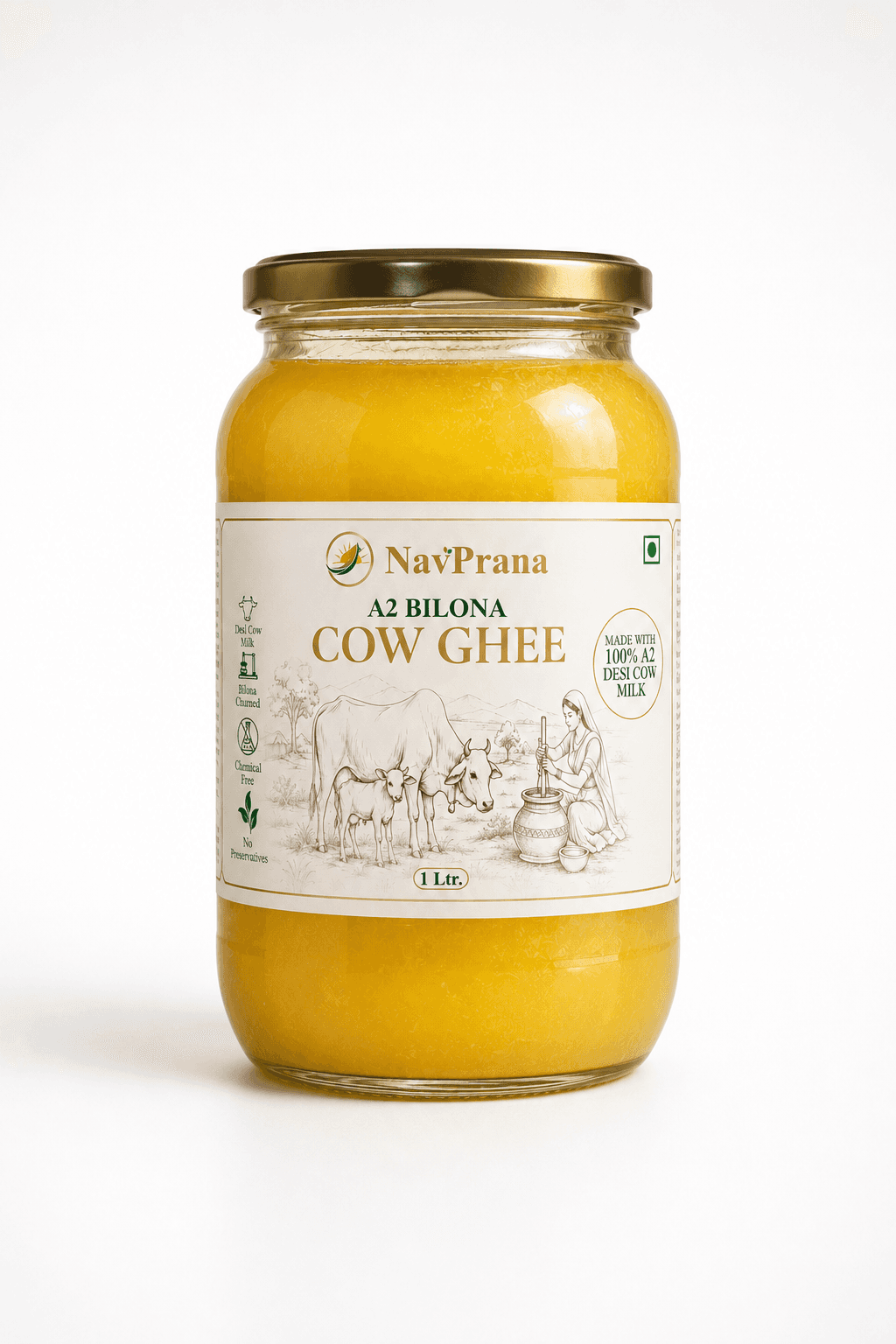
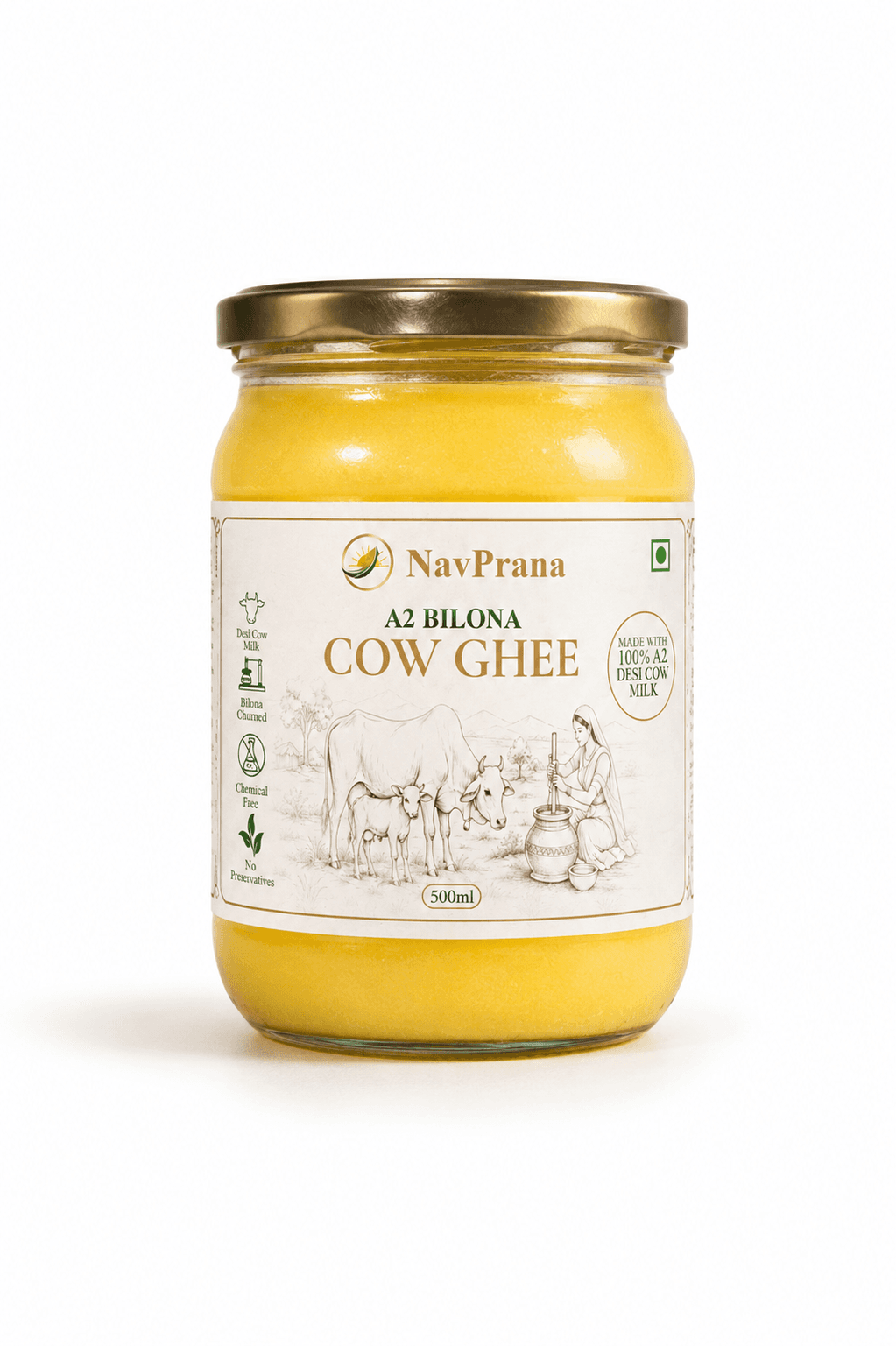
What “A2” actually means
Cow's milk carries beta-casein protein in one of two variants, A1 or A2, depending on the animal's genetics. Indigenous Indian breeds produce predominantly A2. Many of the high-yield crossbred cattle that supply industrial dairy produce A1 instead, because those breeds were selected for volume rather than for what the milk carries.
A lot of people who find ordinary dairy heavy report that A2 sits easier on them. The research on why is still being argued over, and we are not going to overstate it — what we can say is that A2 is the milk Indian households cooked with for generations, and it is the only milk we buy.
“Desi” is the other half of the label. It refers to the breed being native rather than crossbred. A jar marked A2 desi cow ghee should mean both things: native breed, and milk that carries A2 beta-casein.
How our bilona cow ghee is made
Roughly 30 litres of milk go into one litre of ghee, and the whole cycle takes about four times as long as the industrial route. That is the entire reason bilona ghee costs what it does.
- 1
Milking
Milk is collected twice a day from indigenous Indian cow breeds kept on open grazing, not stall-fed on concentrate. It reaches our unit in Morena within a few hours.
- 2
Culturing
The whole milk — not separated cream — is set into curd the same evening with a live starter, and left overnight. Curd made from milk that has sat for a day never churns the same way.
- 3
Hand-churning
The curd is churned by hand the next morning until the butter separates and rises. This is the bilona step that gives the method its name, and it is the step every industrial process skips.
- 4
Slow simmering
Only that butter goes into the pan, over a slow flame, until the water cooks off and the milk solids settle golden at the bottom. Rushing this stage is what makes ghee taste flat.
- 5
Filling
Each batch is filtered, lab tested, and filled into glass. Nothing is added at any stage — no palm oil, no vanaspati, no colour, no preservative, no synthetic flavour.
We buy from smallholder farming families along the Chambal, which is why batches are small and why stock occasionally runs out rather than being topped up from somewhere else.
Cow ghee or buffalo ghee?
We make both, and we will not pretend one is simply better. They behave differently in the pan and on the plate.
| A2 Desi Cow Ghee | A2 Buffalo Ghee | |
|---|---|---|
| Colour | Deep golden | Pale ivory, almost white |
| Texture | Softer, grainy when set | Denser, firmer at room temperature |
| Weight on the stomach | Lighter, easier to digest | Heavier, more sustaining |
| Fat content | Slightly lower; more carotene | Higher; more calcium and phosphorus |
| Cooks best | Dal, roti, khichdi, rice | Halwa, laddoo, sweets, deep frying |
| Traditionally used for | Daily cooking, ayurvedic preparations | Strength, cold weather, festive food |
Want the buffalo one instead? See the full range.
Using it, and keeping it
- A spoon into hot dal or over rice just before serving — this is where cow ghee is at its best, and where the aroma actually comes through.
- For tempering, let the ghee melt fully and shimmer before the seeds go in. It handles the heat; it just should not be smoking.
- Brush it on rotis and parathas straight off the tawa rather than into the dough — you use less and taste more.
- Store the jar closed, away from sunlight, and always use a dry spoon. Water is the only thing that spoils ghee.
- No refrigeration needed. Unopened it keeps 12 months; opened, use within about 6 months while it is aromatic.
A2 desi cow ghee: common questions
What is A2 desi cow ghee?
A2 desi cow ghee is ghee made from the milk of indigenous Indian cow breeds, which produce predominantly A2 beta-casein protein. Many high-yield crossbred cattle produce A1 beta-casein instead. 'Desi' refers to the native breed, and when the ghee is also made by the bilona method it means the milk was cultured into curd and hand-churned rather than centrifuged.
Is A2 cow ghee better than buffalo ghee?
Neither is better in general — they suit different uses. Cow ghee is lighter, more golden, and easier to digest, which makes it the better everyday choice for dal, roti, khichdi and rice. Buffalo ghee is denser and higher in fat, calcium and phosphorus, which suits sweets, deep frying and colder months. Plenty of households keep both.
How is bilona cow ghee different from regular cow ghee?
Most cow ghee on shelves is made by spinning cream out of milk in a centrifuge and clarifying it — fast and cheap. Bilona ghee takes the longer route: whole milk is cultured into curd overnight, the curd is hand-churned to lift out the butter, and only that butter is slowly simmered. It needs roughly 30 litres of milk per litre of ghee and about four times as long, which is why it costs more and why the aroma and grain are different.
How much A2 cow ghee should I use in a day?
For most healthy adults, two to three teaspoons a day across meals is a reasonable amount, and that is roughly what traditional Indian cooking already uses. Ghee is calorie dense, so it is not something to add on top of an existing diet without accounting for it. If you have a specific condition or are managing your weight, ask your doctor or dietitian rather than following a general figure.
How can I tell if cow ghee is pure?
Two things you can check at home. Melt a spoonful in a pan — pure ghee turns to a clear golden liquid almost instantly and leaves no white residue behind. Or chill a little in a glass jar: pure ghee sets as one uniform layer, while ghee cut with vegetable fat separates into distinct layers with different colours.
Does A2 cow ghee need refrigeration?
No. Keep the jar closed, out of direct sunlight, and always use a dry spoon — moisture is the only thing that will spoil it. Unopened it keeps for 12 months; once opened, use it within about 6 months while the aroma is at its best.
Is cow ghee suitable for people who cannot digest milk?
Ghee is almost entirely milk fat — the lactose and most of the milk protein are removed with the solids during simmering, so many people who find milk heavy use ghee without trouble. It is not guaranteed to be lactose free, and anyone with a diagnosed dairy allergy should treat it as a dairy product and check with their doctor.
Can I cook on high heat with cow ghee?
Yes. Ghee has a smoke point around 250°C because the water and milk solids have already been cooked out, so it stays stable at tempering and frying temperatures where many refined oils start to break down.
Read next
Nothing on this page is medical advice. Ghee is a food, and how much of it suits you depends on your own diet and health — talk to a doctor or dietitian for anything specific to you.