

How Much Ghee Per Day Is Safe?
\"Ghee is a superfood.\" \"Ghee makes you fat.\" Both statements are repeated with total confidence, and both are half-true. The line between medicine and excess in Ayurveda has always been quantity — and with ghee, that line is far more generous than the low-fat era taught us, but it is still a line. Here is the number, by age and by goal.
The Quick Answer
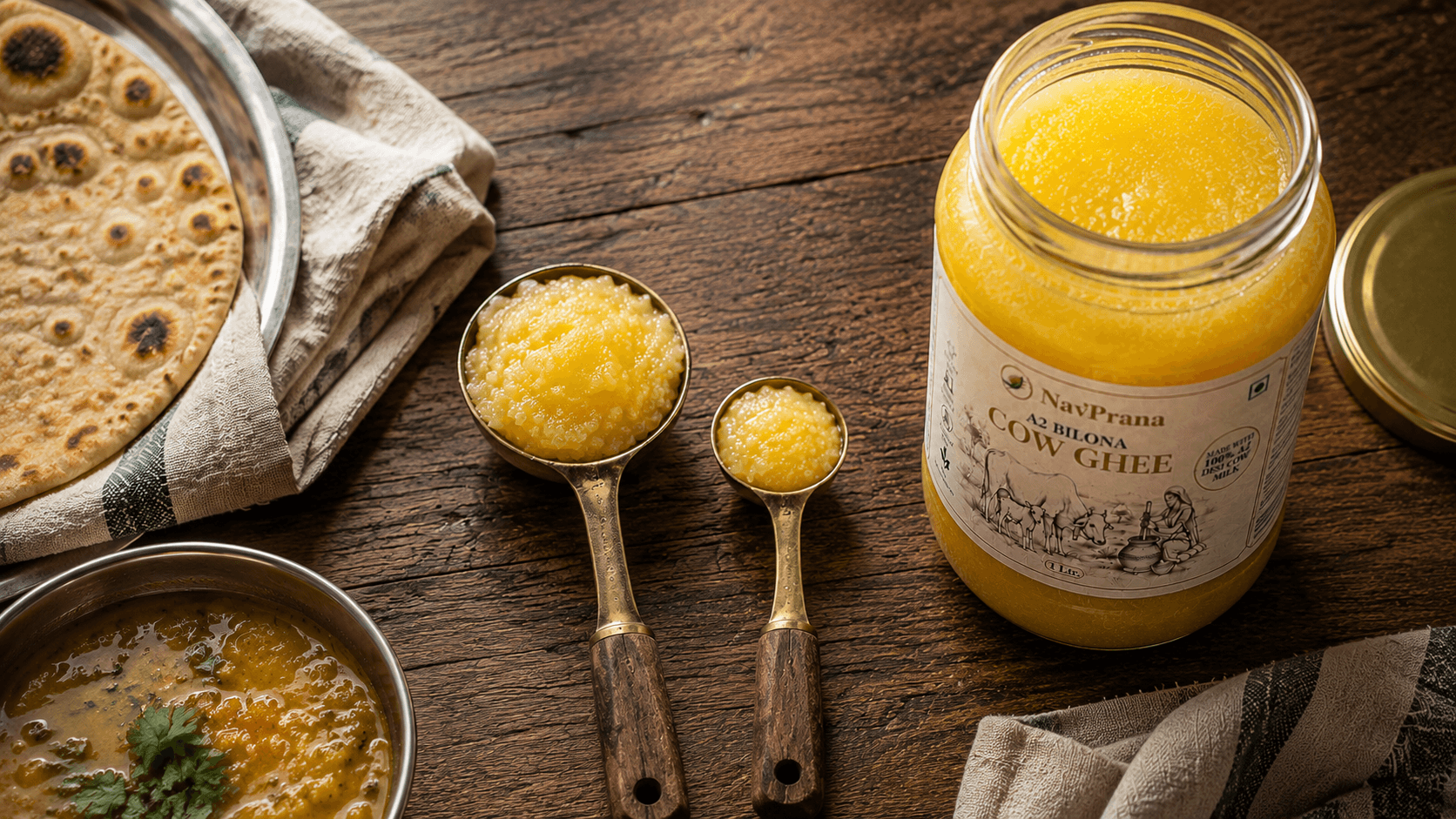
For a healthy adult, 2–3 teaspoons (10–15 g) of pure ghee per day is a safe, beneficial amount — spread across meals rather than taken all at once. Children need less, active people and growing teens can take more, and anyone with diagnosed heart, liver or cholesterol problems should confirm their total daily fat with a doctor. The key rule: replace other cooking fats with ghee, do not add ghee on top of them.
\Daily Ghee Dosage Chart
| Who | Safe daily amount | Best way to take it |
|---|---|---|
| Babies 6–12 months | ¼–1 tsp | Stirred into cooled dal, khichdi or vegetable mash |
| Toddlers 1–5 years | 1–2 tsp | On roti, in rice, dal or porridge |
| Children 6–12 years | 2–3 tsp | Cooking fat + a spoon on hot rice or roti |
| Teens & physically active adults | 3–4 tsp | Across meals; useful pre-workout energy |
| Healthy adults (desk job) | 2–3 tsp | 1 tsp morning ritual + tadka + roti |
| Adults 60+ | 1–2 tsp | Warm food and night milk for joints and regularity |
| Pregnancy & postpartum | 2–3 tsp | Traditionally recommended; confirm with your doctor |
| Weight-loss goal | 1–2 tsp | Counted inside your calorie budget, not on top |
| High cholesterol / fatty liver | ≤1 tsp | Only with your doctor's approval |
1 teaspoon ≈ 5 g ≈ 45 calories. 1 tablespoon ≈ 15 g ≈ 135 calories.
Does Ghee Make You Fat?
Ghee is pure fat, so the honest answer is: it can, if you are careless with the total. But look at the actual arithmetic before you fear it. Two teaspoons a day is about 90 calories — roughly one small banana. That is not what moves the needle on anyone's weight.
What does move the needle is stacking. Cooking in refined oil, then adding ghee to the roti, then ghee in the dal, then ghee-loaded sweets. The problem is never the ghee; it is the third and fourth serving of fat that nobody counted.
Used as a replacement, ghee tends to help weight management for two practical reasons:
- It keeps you full. Fat slows gastric emptying, which means fewer cravings between meals.
- It steadies blood sugar. Adding fat to a carb-heavy meal blunts the spike-and-crash that drives snacking.
Ghee also naturally contains CLA (conjugated linoleic acid), associated with fat metabolism, and butyric acid, which supports gut health. Neither is a weight-loss shortcut — but neither deserves the fear that low-fat marketing built around ghee.
Ghee and Cholesterol: What Actually Matters
Ghee is high in saturated fat, and that is a real number — not something to argue away. But the modern picture is more specific than \"saturated fat is bad\":
- Dose decides everything. Research concerns centre on high-fat diets, not on 10–15 g a day inside an otherwise balanced meal plan.
- What ghee replaces matters. Swapping repeatedly reheated refined oil or vanaspati for a small amount of pure ghee is a step forward, not backward.
- Ghee is heat-stable. With a smoke point around 250°C, ghee does not break down into harmful compounds at Indian cooking temperatures the way many refined oils do.
- Purity is non-negotiable. Adulterated ghee cut with hydrogenated vanaspati carries trans fats — the fat genuinely linked to heart risk. This is an adulteration problem, not a ghee problem.
If you have diagnosed high LDL, fatty liver or heart disease, treat ghee like any other fat in your plan: keep it to about a teaspoon and let your doctor set your total.
Signs You Are Eating Too Much Ghee
Your body signals excess long before a blood test does. Cut back if you notice:
- Heaviness or nausea after meals that does not settle
- Loose stools or an oily film in the stool
- A thick coated tongue and dull appetite in the morning
- Persistent sluggishness after lunch
- Steady weight creeping up despite no other diet change
Ayurveda has a simple test for the right dose: if your appetite returns cleanly at the next mealtime, your quantity is correct.
How to Fit 2–3 Teaspoons Into a Normal Day
- Morning (1 tsp): in warm water on an empty stomach — see what happens after 30 days of this ritual.
- Lunch (½–1 tsp): as the tadka for dal or sabzi instead of refined oil.
- Anytime (½ tsp): on a hot roti or over rice — the classic, and the tastiest.
- Night (½–1 tsp): in warm milk for sleep and easier morning bowel movements.
That is a complete day of ghee without a single \"extra\" spoon anywhere.
Quantity Matters — But Quality Decides
Every number on this page assumes one thing: that what you are eating is actually ghee. Much of what is sold in India is machine-extracted from cream at high heat, or blended with refined oil, vanaspati, colour and essence. With that jar, the safe daily amount is not 3 teaspoons — it is zero.
Real Bilona ghee takes the long route: whole A2 milk set into curd, hand-churned into makkhan, then simmered slowly on a low flame. It is why genuine ghee has that grainy danedar texture, the nutty aroma, and the butyric acid and fat-soluble vitamins that machine extraction destroys. It is also why it takes 25–30 litres of milk to make a single litre — and why the choice between cow and buffalo ghee matters far less than how it was made.
Frequently Asked Questions
Can I eat ghee every day?
Yes. For healthy adults, 2–3 teaspoons daily is a food, not a treatment — Ayurveda has treated it as a daily staple for centuries. Consistency in small amounts beats occasional large quantities.
How much ghee per day for weight loss?
1–2 teaspoons, counted inside your daily calorie target and used to replace other cooking fats. Ghee helps by controlling hunger; it does not burn fat on its own.
Is 1 tablespoon of ghee a day too much?
One tablespoon (15 g, ~135 calories) is at the upper end of normal. It is fine for active people, growing teens and those in winter or recovery — but too much for a sedentary adult who is also eating other fats through the day.
How much ghee should a baby have?
Start with 2–3 drops at 6 months and build to about 1 teaspoon a day by age one. Full age-by-age chart in our guide to ghee for babies.
Does heating ghee destroy its benefits?
No. Ghee's smoke point is around 250°C — higher than almost all Indian cooking — which makes it one of the most heat-stable fats available. Deep-frying repeatedly in the same ghee is still best avoided.
Is ghee safe for diabetics?
In moderation, usually yes — ghee has no carbohydrates and can help blunt the blood-sugar spike from a carb-heavy meal. Keep to 1–2 teaspoons and follow your doctor's guidance on total fat.
Get the Quantity Right — Start With the Right Jar
Two or three teaspoons a day of real, hand-churned ghee will do more for your family than any amount of the factory kind.
- Light, everyday cooking and morning ritual → Desi Cow A2 Bilona Ghee (1 Ltr)
- Richer, for kids, sweets and strength → Buffalo A2 Bilona Ghee (1 Ltr)
Single ingredient, FSSAI certified, made from grass-fed A2 milk in the Chambal valley. Shop the collection → Free shipping on orders above ₹999.
This article is general nutrition information, not medical advice. If you have a diagnosed heart, liver or metabolic condition, ask your doctor before changing your daily fat intake.