

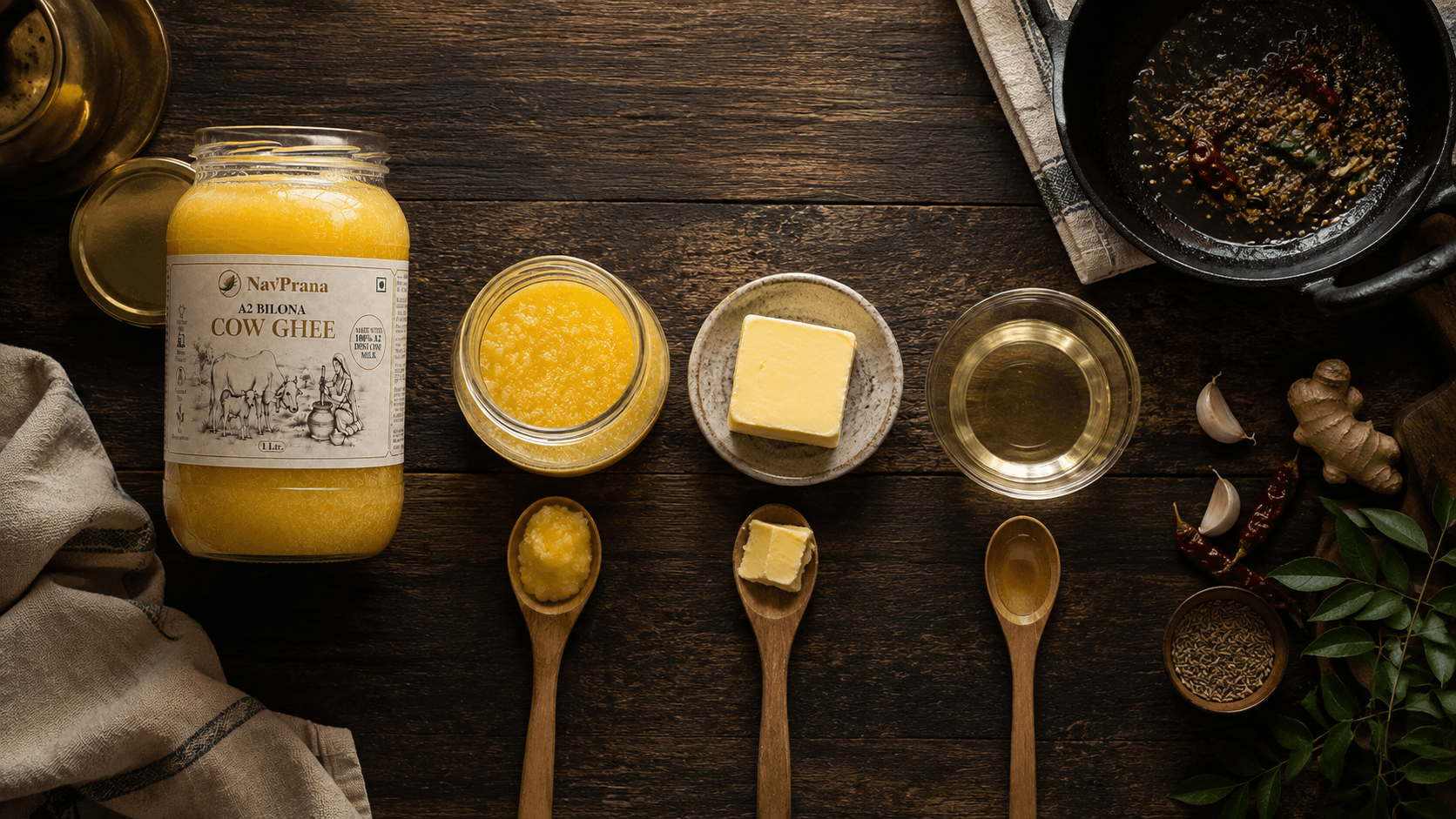
Ghee vs Butter vs Oil: Which Is Healthiest for Indian Cooking?
Your grandmother cooked in ghee. Your mother switched to refined oil because a television advertisement said it was "heart-friendly". Now you are standing in the kitchen aisle, confused all over again. The answer is not about which fat is fashionable — it is about which fat survives the way Indians actually cook. Here is the honest comparison.
The Quick Answer
For Indian cooking, ghee wins on heat stability. With a smoke point of around 250°C, it holds up to tadka, deep-frying and high-flame sabzi without breaking down. Butter is the weakest at heat (it burns around 150°C) but is excellent for baking and spreading. Refined oil handles heat but is chemically extracted and high in omega-6 fats that oxidise when reheated. Use ghee for Indian cooking, cold-pressed oils for low-heat use, and butter for baking.
Side-by-Side Comparison
| Factor | Pure A2 Bilona Ghee | Butter | Refined Oil |
|---|---|---|---|
| Smoke point | ~250°C — safe for all Indian cooking | ~150°C — burns easily | ~220–230°C, but degrades on reheating |
| How it is made | Curd hand-churned, slow-simmered | Cream churned, milk solids retained | Solvent-extracted, bleached, deodorised |
| Water content | None — pure butterfat | ~16–18% water | None |
| Lactose & casein | Removed — usually suits mild dairy sensitivity | Present | None (not a dairy product) |
| Key nutrients | Butyric acid, CLA, vitamins A, D, E, K | Vitamins A and D, less butyric acid | Mostly stripped during refining |
| Fat stability | High — saturated and monounsaturated | Moderate | Low — omega-6 PUFA oxidises with heat |
| Shelf life | 9–12 months, no refrigeration needed | 2–4 weeks, must be refrigerated | 6+ months, but quality falls after opening |
| Ayurveda | Sattvik, balances all three doshas | Heavier, more kapha-forming | Not part of classical Ayurveda |
| Best for | Tadka, frying, rotis, rice, sweets, daily use | Baking, spreading, sauces | Salad dressings (cold-pressed only) |
Why Smoke Point Decides Everything in an Indian Kitchen
Most Western fat comparisons ignore the one thing that matters here: Indian cooking runs hot. A tadka pan hits 200°C in seconds. Deep-frying pooris sits above 180°C. A sabzi on a high flame regularly crosses 200°C.
When a fat is pushed past its smoke point, it stops being food and starts breaking down — releasing free radicals and acrid compounds, and destroying whatever nutrients it carried. This is why butter blackens in a tadka pan while ghee stays clear and fragrant. Ghee's roughly 250°C smoke point gives it headroom that almost no other kitchen fat has.
Ghee vs Butter: Same Origin, Different Product
Ghee begins as butter — but what is removed makes all the difference:
- Water is gone. Butter is about 16–18% water; ghee is pure butterfat. That is why ghee does not splutter and burn.
- Milk solids are gone. These are what scorch in a hot pan — and what contain the lactose and casein. Remove them and you get a far higher smoke point, plus a fat that usually suits people with mild dairy sensitivity.
- Refrigeration is gone. Butter turns rancid within weeks. Ghee sits happily in your kitchen for 9–12 months.
- Butyric acid is concentrated. Ghee delivers more of the short-chain fatty acid that feeds your gut lining.
Butter still deserves a place — for cakes, cookies and toast, its water content and flavour are exactly what the recipe needs. It is simply the wrong tool for a tadka.
Ghee vs Refined Oil: The Comparison Nobody Advertises
Refined oil's high smoke point is real. The problem is everything that happens before the bottle reaches you and everything that happens after you open it.
How refined oil is actually made
Seeds are crushed, then washed with a chemical solvent (usually hexane) to squeeze out the last drop of oil. The result is bleached to fix the colour and deodorised at very high heat to remove the smell. What arrives is stripped of most of its original nutrients — which is why some brands then add vitamins back in and market that as a feature.
The reheating problem
Refined oils are high in omega-6 polyunsaturated fats, which are chemically fragile. Every reheat cycle oxidises them further. That leftover frying oil sitting on the counter and being reused for a third time is the genuine health concern in most Indian kitchens — far more than the saturated fat everyone argues about.
What about the omega-6 balance?
The average Indian diet already runs heavy on omega-6 from refined oils and packaged snacks. Ghee, being mostly saturated and monounsaturated, does not add to that imbalance.
What About Olive Oil, Coconut Oil and Mustard Oil?
- Extra virgin olive oil — genuinely healthy, but its ~190–200°C smoke point and strong flavour suit salads and light sautéing, not a smoking tadka pan.
- Cold-pressed coconut oil — stable and good for South Indian cooking, though the flavour dominates and it burns around 175°C.
- Mustard oil — a strong traditional choice in the east and north, with a high smoke point and a sharp flavour that suits pickles and fish.
- Vanaspati / hydrogenated fat — the one to genuinely avoid. This is where industrial trans fats live, and trans fat is the fat with the clearest link to heart risk.
A well-stocked kitchen usually has two or three fats. The point is not to pick one forever — it is to stop using the wrong one at the wrong temperature.
Which Fat for Which Dish
| Cooking task | Best choice | Why |
|---|---|---|
| Tadka for dal, rasam, sabzi | Ghee | Highest heat tolerance; carries spice aroma |
| Deep frying (puri, samosa) | Ghee or mustard oil | Stable at frying temperature |
| Roti, paratha, hot rice | Ghee | Flavour plus fat-soluble vitamin absorption |
| Halwa, laddoo, sweets | Ghee (buffalo for extra richness) | Traditional taste and texture |
| Cakes, cookies, pastry | Butter | Water content creates the right crumb |
| Salad dressing, dips | Cold-pressed olive oil | No heat involved; good fat profile |
| Reheating leftover fry oil | None — discard it | Repeated heating oxidises the fat |
The Catch: Most "Ghee" on the Shelf Is Not Ghee
Every advantage listed above assumes one thing — that your ghee is real. A large share of what is sold in India is machine-extracted from cream at high heat, or blended with refined oil, vanaspati, colour and essence. That jar carries the refined-oil problem and the trans-fat problem while charging you ghee prices.
Genuine Bilona ghee takes the slow route: whole A2 milk set into curd, hand-churned into makkhan, then simmered gently on a low flame. That process is what preserves the butyric acid, the fat-soluble vitamins, the nutty aroma and the grainy danedar texture. It is also why real bilona ghee costs more — and why it is worth checking your current jar against the signs of fake ghee before you trust it with your family's daily cooking.
NavPrana's Desi Cow A2 Bilona Ghee and Buffalo A2 Bilona Ghee are made exactly this way — one ingredient, nothing added, nothing removed.
Frequently Asked Questions
Is ghee better than refined oil for the heart?
In moderation, pure ghee is a reasonable choice — it is heat-stable and free of trans fats, which are the fats most clearly linked to heart risk. Refined oil's problem is chemical extraction and oxidation on reheating. Quantity still matters for both: see how much ghee per day is safe. If you have diagnosed heart disease or high cholesterol, let your doctor set your total daily fat.
Can I replace all my cooking oil with ghee?
For Indian cooking, largely yes — that was the norm for generations. Keep the total to 2–3 teaspoons a day for an adult, and keep a cold-pressed oil around for salads and low-heat dishes.
Is ghee better than butter for weight loss?
Both are calorie-dense, so neither causes weight loss on its own. Ghee is more concentrated (no water), which means you use less of it for the same flavour — and it keeps you full longer.
Can lactose-intolerant people use ghee instead of butter?
Usually yes. Milk solids — where lactose and casein sit — are removed during the bilona process, leaving only trace amounts. Butter keeps those solids. For a diagnosed milk protein allergy, check with your doctor first.
Does ghee spoil without a refrigerator?
No. Pure ghee has no water, so bacteria cannot grow easily. Kept in a dry jar with a dry spoon and away from sunlight, it stays good for 9–12 months at room temperature.
Make the Switch Where It Matters Most
You do not need to overhaul your kitchen. Start with the fat that takes the most heat — your tadka pan — and the change pays off every single day.
- Everyday cooking, light and versatile → Desi Cow A2 Bilona Ghee (1 Ltr)
- Richer, for frying, sweets and kids → Buffalo A2 Bilona Ghee (1 Ltr)
Not sure which one suits your family? Read our cow ghee vs buffalo ghee comparison. Every jar is hand-churned from grass-fed A2 milk in the Chambal valley and FSSAI certified. Shop the collection → Free shipping on orders above ₹999.