

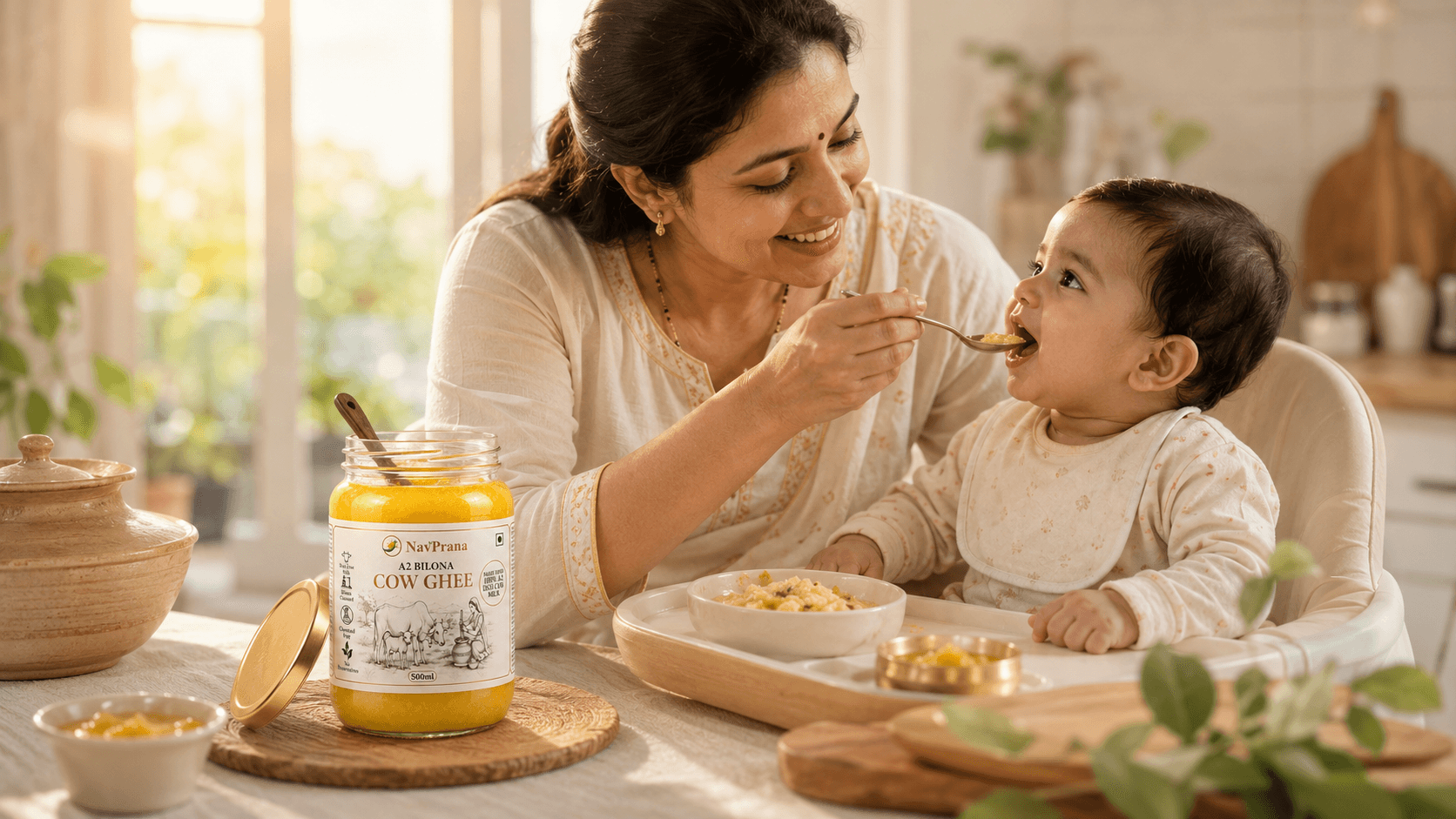
Every Indian grandmother swears by it, and modern nutrition science is catching up: pure desi ghee is one of the best first fats for your baby. But when exactly should you start? How much is safe? And why does the purity of the ghee matter more for a baby than for anyone else in your family? This guide answers everything.
When Can Babies Start Eating Ghee?
Babies can start ghee at around 6 months of age, when solid foods are introduced. Start with just 2–3 drops (about ¼ teaspoon) stirred into cooled dal, khichdi, or mashed vegetables once a day, and increase gradually as your baby grows.
Always consult your pediatrician before introducing any new food, especially if there is a family history of milk allergy.
Age-by-Age Ghee Dosage Chart
| Age | Daily Amount | How to Give |
|---|---|---|
| 6–8 months | 2–3 drops (¼ tsp) | Stirred into cooled dal water or khichdi |
| 8–10 months | ½ tsp | Mixed into mashed khichdi, dal, or sweet potato |
| 10–12 months | ¾–1 tsp | In porridge, khichdi, or vegetable mash |
| 1–2 years | 1 tsp (max) | On rotis, in rice, dal, or halwa |
| 2+ years | 1–2 tsp | Normal family meals |
Rule of thumb: for children under 12 months, stay within one teaspoon per day.
5 Science-Backed Benefits of Ghee for Babies
1. Fuels Brain Development
Nearly 60% of a baby's brain is fat, and the first two years are the fastest period of brain growth in human life. Ghee provides the healthy saturated fats and fat-soluble vitamins (A, D, E, K) that support memory, learning, and nervous system development.
2. Gentle on Tiny Tummies
The butyric acid in ghee nourishes the gut lining, aids digestion, and helps relieve the constipation that is so common when babies start solids. Its medium-chain fatty acids digest more easily than other fats — and ghee's calming qualities can even ease gas and colic.
3. Supports Healthy Weight Gain
Ghee is calorie-dense in the best way — a small amount adds wholesome energy to a baby's small meals, helping underweight babies gain healthily without processed supplements.
4. Builds Immunity
Vitamins A, D, E and K plus natural antioxidants in ghee strengthen a baby's developing immune system — grandma's reason for that spoon of ghee in everything was right all along.
5. Naturally Lactose-Free
Because milk solids are removed during the traditional Bilona process, pure ghee is virtually lactose-free and casein-free — usually safe even for babies with mild dairy sensitivity (confirm with your pediatrician for diagnosed allergies).
⚠️ Why Purity Matters 10x More for Babies
Here is what most parents do not realise: adulterated ghee harms babies far more than adults. Commercial "ghee" is often cut with refined vegetable oils, vanaspati (hydrogenated fat), artificial colours, and essence. A baby's developing liver and gut simply cannot process these the way an adult's can.
What to check before feeding any ghee to your baby:
- Single ingredient: curd-churned butterfat — nothing else. No refined oil, no essence, no colour.
- A2 milk source: A2 protein is gentler on digestion than A1.
- Bilona method: curd → hand-churned butter → slow flame. This preserves butyric acid and vitamins that machine extraction destroys.
- Grainy (danedar) texture and a natural nutty aroma — the signature of real ghee.
- FSSAI certification and transparent sourcing.
NavPrana's Buffalo A2 Bilona Ghee and Desi Cow A2 Bilona Ghee are made exactly this way — from grass-fed A2 milk in the Chambal valley, hand-churned in small batches, with nothing added and nothing removed.
Easy Ways to Add Ghee to Baby Food
- Dal ka pani + ghee (6+ months) — the classic first food.
- Ghee khichdi (8+ months) — comfort food that builds strength.
- Ghee-roasted sweet potato mash (8+ months) — naturally sweet and filling.
- Ghee on warm roti (12+ months) — soft, easy to chew.
- Gentle ghee massage before bath — an age-old practice for soft skin and better sleep.
Frequently Asked Questions
Can ghee cause a cold or cough in babies?
No — this is a myth. Pure ghee is not "cooling" or mucus-forming when given in the right quantity. In Ayurveda, ghee is actually used to balance and soothe. Excess quantity, not ghee itself, causes digestive discomfort.
Cow ghee or buffalo ghee — which is better for my baby?
Both are safe after 6 months. Cow ghee is lighter and a common first choice; buffalo ghee is denser in calories, which helps babies who need to gain weight. Read our full cow ghee vs buffalo ghee comparison.
Can I give ghee to my baby every day?
Yes — daily ghee within the age-appropriate amounts above is beneficial. Consistency in small amounts beats occasional large quantities.
My baby is lactose intolerant. Is ghee safe?
Usually yes, because pure bilona ghee contains only trace lactose. For a diagnosed milk protein allergy (CMPA), consult your pediatrician first.
Give Your Baby the Purest Start
Your baby's first fats shape their growth, immunity, and brain for life. Do not compromise with factory ghee. Order NavPrana A2 Bilona Ghee — hand-churned, FSSAI certified, single-ingredient ghee that is pure enough for the smallest member of your family. Free shipping above ₹999.