

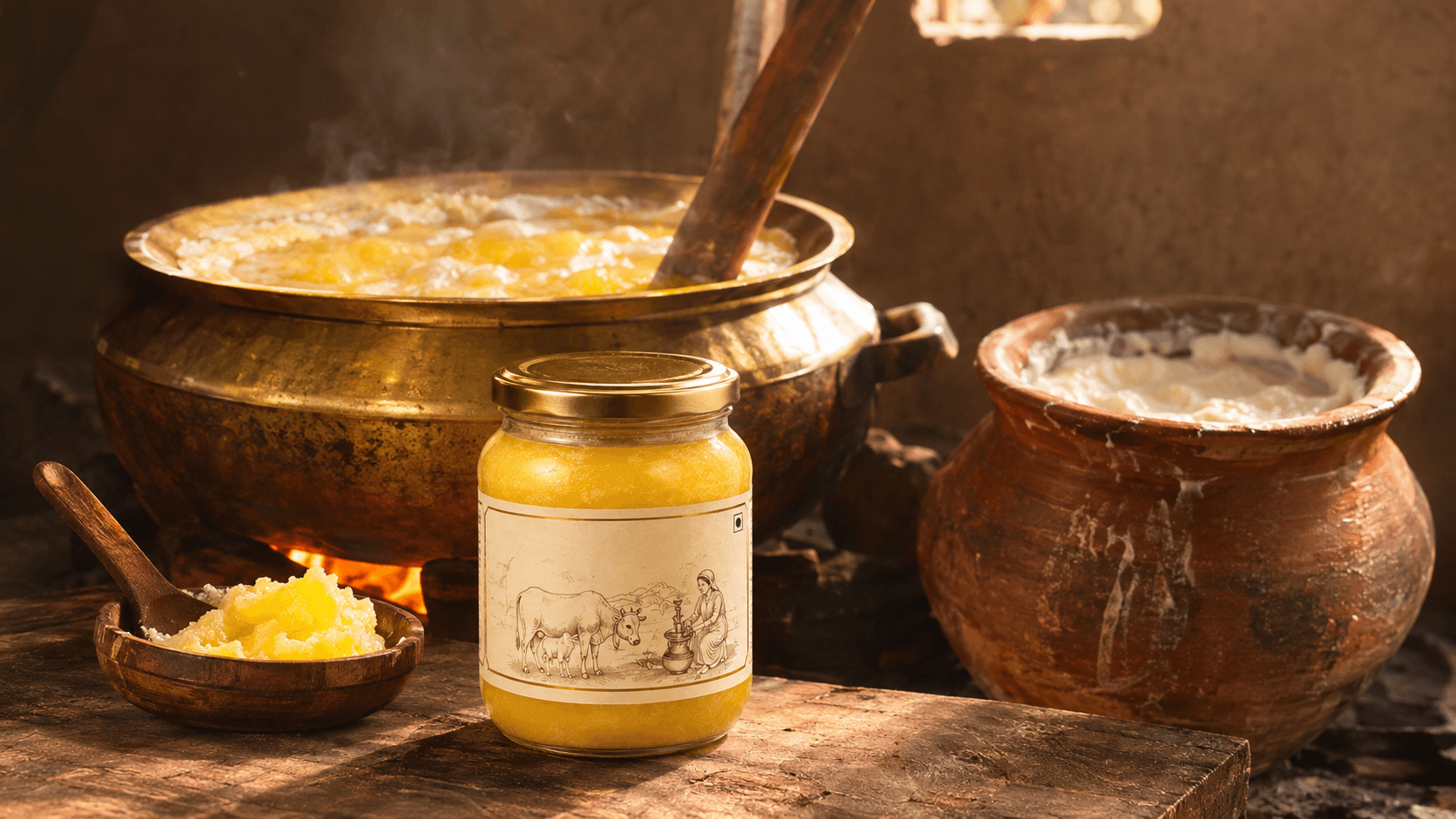
What Is Bilona Ghee? How It Is Made vs Machine-Made Ghee
Two jars sit on the same shelf. Both say ghee. One costs four times the other, and the expensive one has the word bilona on the label. Almost nobody selling it bothers to explain what that word means, which is convenient, because bilona is not a grade or a certification. It is a method. Once you know the four steps, you can tell in about thirty seconds whether a brand is describing a process or reciting a marketing word.
The Quick Answer
Bilona ghee is made from whole milk that is first turned into curd, then hand-churned into butter, then simmered slowly into ghee. Four steps: milk, curd, makkhan, ghee. Machine-made ghee skips the curd entirely. It runs milk through a cream separator, converts the cream straight to butter, and clarifies it at high heat in minutes. The curd step is the whole difference, and it is why bilona takes hours and far more milk. One more thing worth knowing before you pay the premium: the word bilona has no legal definition in India, so anyone can print it.
Bilona vs Machine-Made, Side by Side
| Factor | Bilona (curd-churn) | Machine-made (cream separator) |
|---|---|---|
| Starting point | Whole milk | Cream, mechanically separated from milk |
| Curd step | Yes, essential. Milk is cultured first. | None. Milk is never fermented. |
| Churning | By hand, or with a slow wooden churn | High-speed mechanical churn |
| Heat | Low, slow simmer | High heat, rapid clarification |
| Time per batch | Hours, plus overnight curd setting | Minutes |
| Milk required | Considerably more per litre of ghee | Less, since cream is concentrated first |
| Texture | Grainy, crystalline danedar | Smooth and uniform |
| Aroma | Pronounced, nutty, cultured | Flat and mild |
| Legal status of the term | Not defined by FSSAI | "Ghee" itself is defined and regulated |
| Typical price | Premium | Standard |
The Four Steps
- Set the curd. Whole milk is boiled, cooled to roughly body temperature, cultured with a spoon of existing curd, and left overnight. This is the step that machine ghee never performs.
- Churn to makkhan. The set curd is churned until the butterfat gathers and separates from the buttermilk. Traditionally this is done with a wooden staff, the bilona, which is where the name comes from. The leftover buttermilk is not waste; it is chaas.
- Simmer low and slow. The makkhan goes into a heavy vessel over a low flame. Water evaporates, the milk solids sink and brown gently, and the fat turns clear gold. Rushing this step with high heat is exactly what damages the fat.
- Separate and strain. Once the solids settle and the aroma turns nutty, the ghee is strained off and left to cool slowly. Slow cooling is what produces the grainy texture.
That is the whole method. No additives, no shortcuts, one ingredient.
Why the Curd Step Is the Entire Argument
Strip away the marketing and the bilona case rests on one thing: fermenting the milk before you separate the fat.
Culturing changes what happens next. The bacteria act on the whole milk, developing the aroma compounds and the cultured character you can smell in the finished ghee. The fat is then separated from a fermented base rather than pulled straight out of raw cream. Indian dairy-science literature has compared these preparation routes and finds they do not produce identical products, particularly in flavour compounds and free fatty acid profile.
The second half of the argument is heat. Low and slow protects the fat. Fast industrial clarification stresses it. That shows up in aroma first, and in the grainy texture that machine ghee rarely develops.
Classical Ayurveda arrived at the same sequence long before anyone measured it, and ghrita prepared this way remains the base for a large number of formulations listed by the Ministry of Ayush.
Why It Needs So Much Milk
Because you are working from whole milk rather than concentrated cream, and because the curd-churn route leaves fat behind at every transfer. A separator is built to extract efficiently. A wooden churn is not.
That inefficiency is the cost. It is also why bilona ghee cannot be produced at industrial scale, and why a brand selling it cheaply at volume is worth a second look. Our cost breakdown goes through the arithmetic.
What "Bilona" Legally Means in India: Nothing
This is the part you will not read on a competitor's page, including brands we compete with directly.
India's Food Safety and Standards regulations define ghee as a product, with a compositional standard covering things like milk fat content and moisture. What they do not define is bilona. Or vedic. Or hand-churned. Or A2, for that matter. There is no certification body, no audit, and no penalty for printing the word on a jar of machine ghee.
So the honest position is this. The method is real and it does produce a different product. The label claiming the method is unverified by anyone. Judge the brand, not the adjective.
How to Verify a Bilona Claim
Ask, and see whether you get specifics or adjectives:
- How many litres of milk per litre of ghee? A real producer knows this number for their own batches.
- Is the milk cultured into curd first, or is cream separated? The vague answer here tells you everything.
- Where is the facility, and can you see photographs of the actual process rather than stock imagery?
- What is the batch size? Genuine bilona means small batches. A brand claiming both bilona and industrial volume is claiming something impossible.
- Is there one ingredient on the label, or a list?
Then check the jar itself. Real bilona ghee is grainy, smells strongly nutty, and sets unevenly in winter. Cow ghee runs golden from beta-carotene, buffalo ghee sets creamy white. Perfectly smooth pale ghee in an Indian winter deserves suspicion. FSSAI publishes a free booklet of rapid at-home adulteration tests, and our own guide covers the signs of fake ghee. If your jar has turned grainy and you were worried about it, read why that is a good sign.
Bilona, Vedic, Hand-Churned, A2: Sorting the Labels
- Bilona describes the method. Milk to curd to makkhan to ghee.
- Vedic is a marketing synonym for the same thing. It carries no extra meaning.
- Hand-churned refers to step two specifically. It is compatible with bilona but does not by itself confirm the curd step.
- A2 is about the cow's beta-casein genetics, which is a separate question entirely. It matters less in ghee than most labels suggest, and we explain why in our A2 vs A1 guide.
A jar can be A2 and still machine-made. A jar can say bilona and be neither. The words stack independently, which is precisely why they get stacked.
Where Bilona Does Not Matter Much
Worth stating plainly, since this post is otherwise an argument for the method.
If you use a spoon of ghee a week on a roti, the difference between bilona and a good machine-made ghee will not change your health in any measurable way. Method matters most when ghee is a daily food, when it goes to a baby or an expecting mother, or when you are taking it undiluted on an empty stomach. And a genuinely pure machine-made ghee from a reputable dairy is a far better buy than an adulterated jar with bilona printed on it. Purity first. Method second. Marketing last.
Frequently Asked Questions
Bilona ghee kya hai?
Bilona ghee traditional tareeke se banta hai: doodh ko pehle dahi jamaya jata hai, phir usse haath se bilo kar makkhan nikala jata hai, aur us makkhan ko dheemi aanch par pakaa kar ghee banaya jata hai. Machine ghee mein dahi ka step hota hi nahi, cream se seedha ghee banta hai. Dahi ka step hi asli farak hai.
Bilona aur normal ghee me kya farak hai?
Three differences that matter: bilona ferments the milk into curd first, churns slowly, and simmers on a low flame. Machine ghee separates cream, churns fast and clarifies at high heat. The result is different in aroma, in the grainy danedar texture, and in how much milk it took to make.
Is bilona ghee actually better for health?
It is a better-made product, with more aroma, the traditional grainy texture and less heat damage to the fat. Whether that translates into a measurable health difference for a person eating one or two teaspoons a day is not something the evidence settles. Buy it for quality and process, and treat any brand promising specific health outcomes with suspicion.
Why is bilona ghee so expensive?
It takes far more milk per litre, hours instead of minutes, and small batches that cannot be scaled. Full arithmetic in our cost breakdown.
Is machine-made ghee bad?
No. Pure machine-made ghee from a reputable dairy is a real food and a reasonable buy. It has less aroma and usually lacks the grainy texture, and the fat has taken more heat. The genuine problem in the Indian market is not machine ghee, it is adulterated ghee cut with refined oil and vanaspati, sold at either price point.
How do I know if my ghee is really bilona?
You cannot confirm it from the jar alone, since the term is unregulated. Judge it on specifics: does the brand publish its milk-to-ghee ratio, its location and its batch size, and does the ghee itself come out grainy and strongly aromatic? Vague answers are the answer.
Judge the Method, Not the Word
Every jar we sell goes through the four steps on this page. Whole A2 milk set into curd, hand-churned into makkhan, simmered on a low flame, strained and cooled slowly. One ingredient on the label because there is nothing else in it.
- Golden and lighter, for daily cooking and morning routines: Desi Cow A2 Bilona Ghee (1 Ltr)
- Creamy white and denser, for sweets, kids and winter: Buffalo A2 Bilona Ghee (1 Ltr)
Not sure which suits your kitchen? Start with our cow ghee vs buffalo ghee comparison. FSSAI certified, made from grass-fed A2 milk in the Chambal valley. Shop the collection → Free shipping on orders above ₹999.
General food information, not medical advice. Claims about production methods on this page describe our own process; the term bilona is not certified by any regulatory body in India, ours included.