

How to Choose Ghee: 7 Checks to Run Before You Buy
Twelve jars on a shelf. Prices ranging from a few hundred rupees a litre to a few thousand. Every single label says pure, every one shows a cow, and most of them mention tradition somewhere. The label is the least reliable thing on the jar. These seven checks take about two minutes and they work whether you are standing in a store or scrolling a product page.
The Quick Answer
Check the ingredient list first. If it says anything other than ghee or butterfat, put it back. Then check how it was made (curd-churned or cream-separated), where the milk came from, whether the texture is grainy, what the packaging is, whether the price makes arithmetic sense, and how the brand answers a direct question. A jar that passes all seven is rare. A jar that fails the first one is not worth the other six.
The Seven Checks
| # | Check | Good sign | Red flag |
|---|---|---|---|
| 1 | Ingredient list | One ingredient | Refined oil, vanaspati, colour, essence, flavour |
| 2 | Method | Curd churned, bilona, stated plainly | Method not mentioned at all |
| 3 | Milk source | Named breed, named region, grass-fed | Only adjectives, no location |
| 4 | Texture | Grainy, crystalline danedar | Perfectly smooth and uniform |
| 5 | Packaging | Glass, opaque or stored away from light | Thin clear plastic on a bright shelf |
| 6 | Price arithmetic | Costs at least what the milk costs | Cheaper than the milk it claims to use |
| 7 | Answers | Specific numbers when asked | Adjectives, or no reply |
1. The Ingredient List
This is the fastest filter and it eliminates most of the shelf. Pure ghee has one ingredient. India's food safety regulations define what may legally be sold as ghee and require the label to declare what is in the pack, so anything added has to appear there.
Watch for refined vegetable oil, vanaspati or hydrogenated fat, artificial colour, and anything described as flavour or essence. Vanaspati is the serious one, because it means industrial trans fat , the one fat category with clearly established harm. Also be wary of the word blended, and of products labelled ghee-based or table spread rather than ghee.
2. How It Was Made
Two routes exist. Milk is either cultured into curd, churned into makkhan and then simmered, which is the bilona method, or cream is mechanically separated from milk and converted directly at high heat. The curd step is the difference, and it changes aroma, texture and how much heat the fat took.
What matters here is whether the brand says. A producer using the slow method will describe it, because it is expensive and they want credit for it. Silence on method almost always means the cream separator. Our guide to what bilona actually means covers the four steps, including the uncomfortable fact that the word carries no legal protection in India.
3. Where the Milk Came From
Ghee is roughly 99% fat, so what the animal ate is most of what you are buying. Grazed animals produce fat with more beta-carotene, which is the golden colour in cow ghee, and a different aroma profile.
Look for specifics: the breed, the district, the herd. A brand naming Gir or Sahiwal cows in a named region is making a checkable claim. A brand saying pure desi cows from the heartland of India is saying nothing. If the label mentions A2, read our A2 vs A1 guide first, because that claim matters less in ghee than the packaging suggests.
4. Texture and Aroma
Real ghee made the slow way is grainy. Different fats in it crystallise at different temperatures, so as a jar cools you get the visible danedar grain that Indian kitchens have recognised for generations. Highly processed ghee tends to stay smooth and uniform.
Aroma is the other tell. Good ghee smells nutty and warm, almost caramelised. A flat or faintly chemical smell means it was rushed or cut with something. If you already own a jar you are unsure about, FSSAI publishes a free booklet of rapid at-home adulteration tests , and our own guide covers the signs of fake ghee . And if your jar has gone grainy in winter, that is a good sign rather than spoilage .
5. Packaging
Glass is better than plastic, and away from light is better than under it. Light and air both drive oxidation in fats, which is what turns ghee rancid. A clear plastic bottle sitting under supermarket lights for months is the worst combination on the shelf.
This one is easy to over-weight, though. Packaging tells you how the product was handled, not what is inside it. Check it fifth, not first.
6. The Price Arithmetic
This is the check almost nobody runs, and it exposes more fakes than any lab test you can do at home.
Ghee is concentrated milk fat. It takes many litres of whole milk to make one litre of ghee by the traditional route. So work backwards:
- Take the price of a litre of full-cream milk where you live.
- Multiply it by the number of litres needed per litre of ghee.
- That is the raw material cost, before labour, fuel, packaging, testing, margin or shipping.
If a jar is selling below that number, the milk in it is not what the label claims. Something has been substituted, or the ghee came from cream that was a byproduct of another process, or it is blended. The arithmetic does not bend. Our cost breakdown walks through the full calculation.
Do the sum once with your local milk price and you will never look at a cheap jar the same way again.
7. What Happens When You Ask
The last check is the most revealing, and it costs one message.
Ask a brand three questions: how many litres of milk per litre of ghee, where is the facility, and what is the batch size. A real producer answers all three with numbers, because they know them. A reseller answers with adjectives, changes the subject, or does not reply.
This works because the answers are not something marketing can generate. Either you run the kitchen or you do not.
When a Cheaper Ghee Is the Right Call
Worth saying, since everything above argues upward.
If you use ghee occasionally, a spoon on a roti once or twice a week, a pure but machine-made ghee from a reputable dairy is a sound buy and the premium will not change anything measurable for you. Method matters most when ghee is daily food, when it goes to a baby or an expecting mother, or when you take it undiluted on an empty stomach.
And this is the real hierarchy: a genuinely pure machine-made ghee beats an adulterated jar with bilona printed on it, every time. Purity first. Method second. Marketing last. A brand charging a premium while failing check one is worse than the plain dairy tin, not better.
How We Answer Our Own Seven
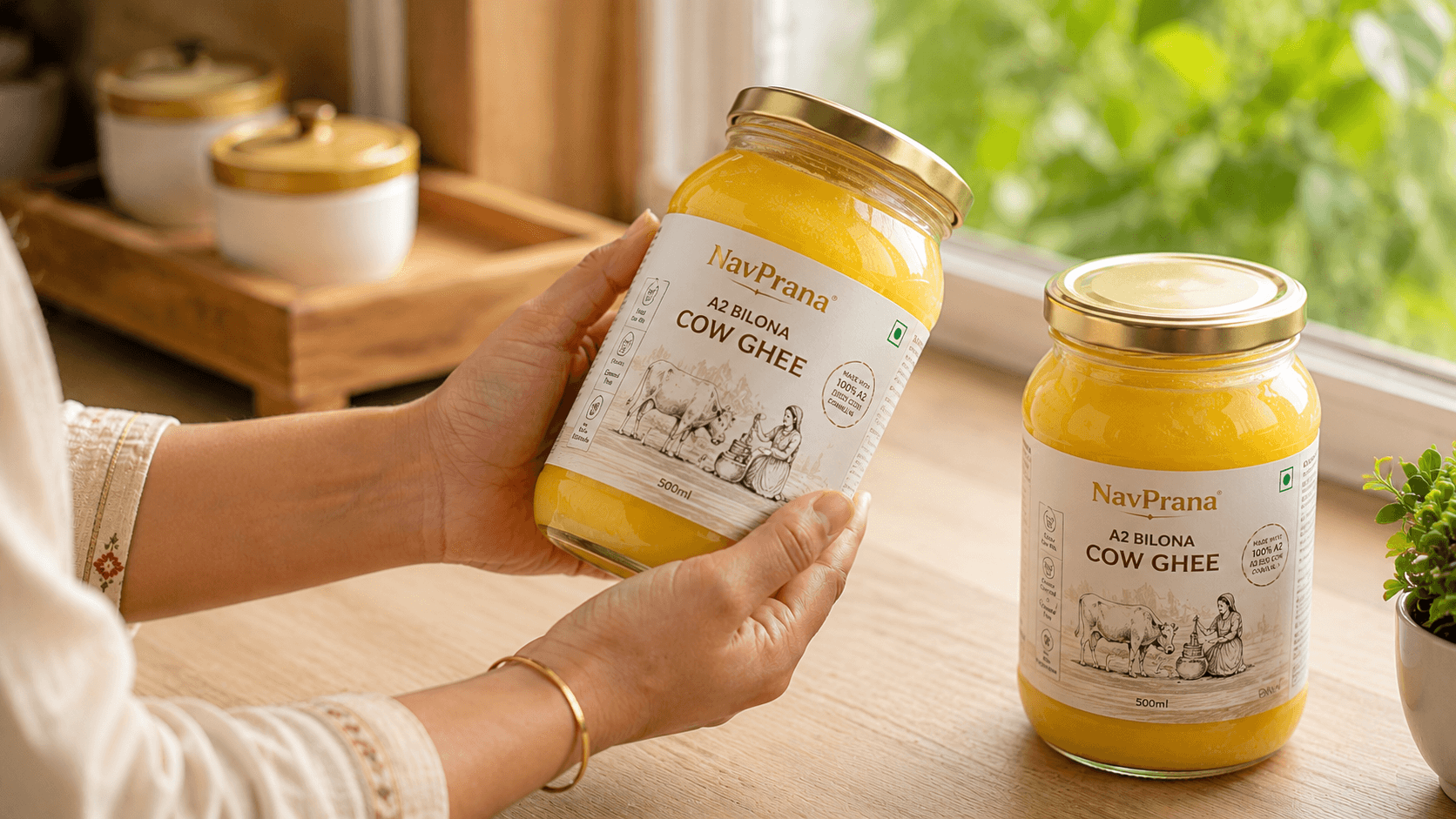
It would be poor form to publish this list without standing on it. NavPrana ghee is one ingredient, curd-churned by the bilona method, made from grass-fed A2 milk in the Chambal valley, sold in glass, grainy in the jar, and FSSAI certified. Ask us the three questions in check seven and you will get numbers.
Not sure which of ours suits your kitchen? The cow ghee vs buffalo ghee comparison is the place to start.
Frequently Asked Questions
Accha ghee kaise pehchane?
Sabse pehle ingredient list dekhein, usme sirf ek cheez honi chahiye. Phir texture dekhein, asli bilona ghee daanedaar hota hai, ekdum smooth nahi. Sungh kar dekhein, khushbu meethi aur nutty honi chahiye. Aur sabse zaroori, keemat ka hisaab lagayein: jitna doodh lagta hai ek litre ghee banane mein, agar jar usse sasta hai to usme doodh utna hai hi nahi.
Ghee kharidte samay kya dekhe?
Saat cheezein, isi kram mein: ingredient list, banane ka tareeka, doodh kahan se aaya, texture, packaging, keemat ka ganit, aur brand se seedha sawaal poochne par kya jawab milta hai. Pehli cheez mein hi zyadatar jars bahar ho jaate hain.
Kya mehnga ghee hamesha accha hota hai?
Nahi. Keemat sirf ek check hai saat mein se, aur wo sirf niche ki seema batati hai, upar ki nahi. Bahut mehnga ghee bhi machine se bana ho sakta hai ya milawti ho sakta hai. Sasta ghee sandeh paida karta hai, par mehnga ghee apne aap koi guarantee nahi hai.
Is a higher price always a sign of better ghee?
No. Price sets a floor, not a ceiling. Below a certain price the milk arithmetic cannot work, so cheap ghee tells you something real. Above that line, price tells you very little, because branding and packaging cost money too. Run the other six checks.
Should I buy ghee online or from a local dairy?
Either works if the seven checks pass. A local dairy you can visit is a strong option, since you can see the operation. Online is fine when the brand publishes specifics and answers questions. What does not work is an unbranded tin from an unknown source at a suspiciously good price.
What if a brand refuses to answer my questions?
Treat that as the answer. Producers know their own numbers, and the ones proud of their process volunteer them. Silence or vagueness on milk ratio, location and batch size is the clearest signal you will get without a lab.
Run the Seven Checks on Us
We would rather be judged on the list than on the label.
- Lighter and golden, for daily cooking: Desi Cow A2 Bilona Ghee (500 ml) or the 1 litre
- Creamier and denser, for sweets, kids and winter: Buffalo A2 Bilona Ghee (500 ml) or the 1 litre
One ingredient, FSSAI certified, hand-churned in small batches from grass-fed A2 milk. Shop the collection → Free shipping on orders above ₹999.
General consumer guidance, not a laboratory method. For official testing information see Eat Right India . If you suspect a product is adulterated, report it to FSSAI.