

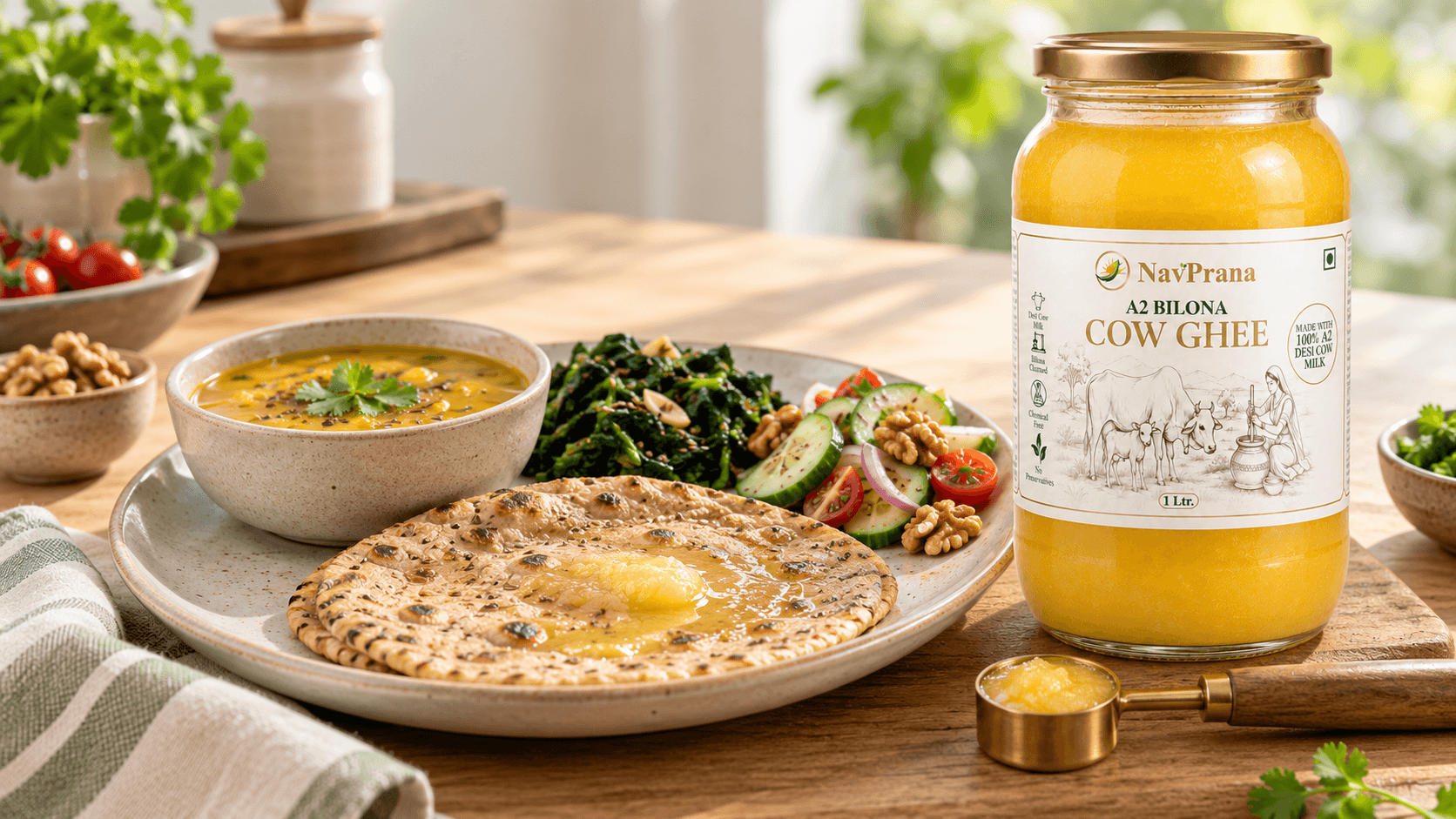
Your doctor said cut the ghee. Your grandmother says ghee is what kept her generation healthy. An article you read last week said saturated fat was never the problem at all. Ghee is high in saturated fat, and we are not going to pretend otherwise on our own website. What follows is the careful version, including the parts that argue against us, because if you are managing your lipid numbers you deserve better than a brand telling you what you want to hear.
The Quick Answer
Ghee is roughly 60 to 65 percent saturated fat, and for most people, eating a lot of saturated fat raises LDL cholesterol. That much is not seriously disputed. What is disputed is how much that matters at small quantities inside an otherwise reasonable diet. One to two teaspoons a day, used to replace the oil or butter you already cook with, is unlikely to move your numbers meaningfully. Four or five spoons added on top of everything else is a different conversation. And if you already have high LDL or diagnosed heart disease, your doctor sets your limit, not an article and certainly not a ghee brand.
What Raises Your Numbers, Ranked
| Factor | Effect on lipids | How strong is the evidence |
|---|---|---|
| Trans fat (vanaspati, bakery fat) | Raises LDL and lowers HDL. The worst combination. | Very strong. No safe level. |
| Body weight and waist size | Major driver of triglycerides and HDL | Very strong |
| Refined carbs and sugar | Raises triglycerides, lowers HDL | Strong. Under-discussed in India. |
| Physical inactivity | Lowers HDL, worsens the whole panel | Strong |
| Smoking | Lowers HDL, damages arteries directly | Very strong |
| Saturated fat in large amounts | Raises LDL | Strong, though the link to actual heart events is debated |
| Saturated fat, 1-2 tsp of ghee daily | Small, often not measurable | Weak effect at this dose |
| Genetics and family history | Can dominate everything above | Strong. Not modifiable. |
The Honest Position on Saturated Fat
Two camps shout at each other online and both overstate their case.
The old position was that saturated fat causes heart disease, full stop. That produced the low-fat era, which pushed Indians toward refined oils and packaged low-fat products loaded with sugar. It did not go well.
The revisionist position is that saturated fat was exonerated and you can eat ghee freely. That is not what the research says either. The literature on saturated fat and cardiovascular risk is genuinely contested, particularly on whether raised LDL from saturated fat translates into more heart events at moderate intakes.
The defensible middle: saturated fat does raise LDL for most people, the relationship with actual outcomes is less certain than either camp admits, dose matters enormously, and what you replace it with matters as much as the fat itself. Research specifically on ghee and lipid profile exists but is mostly small studies and animal work, so treat any confident claim in either direction with suspicion.
The Fat You Should Really Worry About
If cholesterol is on your mind, this is where your attention belongs, and it is not saturated fat.
Trans fat raises LDL and lowers HDL at the same time. The World Health Organization treats industrially produced trans fat as something to eliminate from the food supply entirely, and it is the clearest dietary link to cardiovascular risk we have. The WHO also identifies unhealthy diet among the main behavioural risk factors for cardiovascular disease , which remains India's leading cause of death.
Where does trans fat come from in an Indian kitchen? Vanaspati, bakery products, commercially fried snacks, and adulterated ghee . That last one is the uncomfortable irony of this whole topic. A person avoiding pure ghee for their heart while eating a cheap blended jar of it has the risk exactly backwards.
Repeatedly reheated frying oil deserves a mention too. That is a real and common problem in Indian homes, and it gets far less attention than it should.
How Much Is Sensible
| Situation | Daily ghee | Note |
|---|---|---|
| Normal lipids, healthy weight | 2-3 tsp | As a replacement for other cooking fat |
| Borderline LDL | 1-2 tsp | Cut fried food and refined carbs first |
| Diagnosed high LDL | Doctor decides, often ≤1 tsp | Do not self-prescribe |
| Existing heart disease or post-event | Doctor decides | Follow your cardiologist, not an article |
| High triglycerides | 1-2 tsp | Sugar, alcohol and refined carbs matter more here than fat |
| Family history, numbers normal | 1-2 tsp | Get tested regularly rather than guessing |
One teaspoon is about 5 g and roughly 45 calories. Count cooking ghee inside this. ICMR-NIN's Dietary Guidelines for Indians set ceilings on total visible fat, covering ghee, oil and butter together. Our age-wise dosage guide has the full breakdown.
Replace, Do Not Add
This is the single most useful idea on the page, and it resolves most of the confusion.
A teaspoon of ghee is about 45 calories. A teaspoon of refined oil is about 40. Swapping one for the other is close to calorie-neutral , and you gain heat stability and lose the chemical extraction and the oxidation that comes with repeatedly reheating polyunsaturated oils.
What harms people is stacking: cooking in refined oil, then adding ghee to the roti, then more in the dal. That is three fats where there should be one. Pick one fat per meal, measure it, and your total does not move.
What Ghee Will Not Do
Plainly, because this is where ghee marketing in India goes badly wrong.
Ghee does not lower cholesterol. Any brand, influencer or article claiming it clears arteries, dissolves plaque or improves your lipid profile is making a health claim with nothing behind it. Treat that as a reason to distrust everything else they say, including their purity claims.
It does not offset a sedentary week, it does not cancel out fried food, and it does not override genetics. Familial hypercholesterolaemia is not a diet problem.
And it is not a heart tonic. It is a cooking fat, and a good one, which is a smaller and more useful claim.
What Really Moves Your Numbers
- Losing weight if you are carrying extra, which improves triglycerides and HDL more reliably than any single food change.
- Cutting refined carbs and sugar. In Indian diets this is frequently the bigger lever than fat, and it is rarely the one people are told to pull.
- Walking most days. Thirty minutes, consistently.
- Eliminating trans fat. Bakery items, commercially fried snacks, vanaspati, and cheap blended ghee.
- Not smoking, which affects HDL and arteries directly.
- Taking prescribed medication if your doctor has prescribed it. Statins are not something to replace with a home remedy, and people do try.
- Getting a lipid panel done rather than assuming. Many Indians with high LDL feel completely fine.
If You Are Going to Eat It, Eat the Real Thing
Given everything above, the priority order is clear. Purity matters more than quantity, and quantity matters more than the saturated fat debate.
Much of the ghee sold cheaply in India is machine-extracted from cream at high heat, and the cheaper jars are frequently blended with refined oil, vanaspati, colour and essence. That product carries the trans-fat problem while you believe you are eating something traditional and wholesome. India's food safety regulations require the ingredient list to declare what is in the pack. Read it. One ingredient.
Real Bilona ghee is whole A2 milk set into curd, hand-churned into makkhan, then simmered on a low flame. See what bilona actually means , and run any jar past the seven checks before you buy.
Frequently Asked Questions
Ghee se cholesterol badhta hai kya?
Ghee mein saturated fat zyada hota hai, aur bahut zyada saturated fat khane se zyadatar logon ka LDL badhta hai. Par roz ek do chammach, wo bhi apne purane cooking oil ki jagah, aam taur par numbers par dikhne layak asar nahi daalta. Dikkat tab hoti hai jab ghee upar se add hota hai, ya matra chaar paanch chammach chali jaati hai. Agar LDL pehle se high hai to matra doctor tay karein.
Cholesterol me ghee kha sakte hai?
Aam taur par thodi matra mein haan, par ye faisla aapke doctor ka hai, kisi article ka nahi. Agar LDL badha hua hai to ek chammach se zyada nahi, aur pehle talе hue khaane, bakery items aur refined carbs kam karein, kyunki wo aksar ghee se zyada nuksan kar rahe hote hain.
Heart ke liye ghee accha hai kya?
Ghee koi heart tonic nahi hai aur na hi wo dhamniyan saaf karta hai. Jo brand ye daawa kare, uski baaki baaton par bhi bharosa mat kijiye. Ghee ka asli fayda ye hai ki wo tez aanch par kharab nahi hota aur shudh hone par usme trans fat nahi hota. Trans fat hi wo charbi hai jiska dil ki bimari se sabse saaf sambandh hai.
Is ghee better than refined oil for cholesterol?
Neither is a treatment. Ghee is more heat-stable and free of trans fat when pure, which is a real advantage in Indian cooking. Refined oil is lower in saturated fat but is chemically extracted and oxidises when reheated. If your LDL is high, the amount of any fat matters more than the choice between them.
My doctor told me to stop ghee completely. Should I?
Follow your doctor. They have your lipid panel, your family history and your other risk factors, and we have none of that. If you want to understand the reasoning, ask them whether the concern is total fat, LDL specifically, or weight. That answer usually tells you whether a small measured amount could come back later.
Does ghee raise triglycerides?
Triglycerides respond most strongly to refined carbohydrate, sugar, alcohol and excess calories rather than to dietary fat. If your triglycerides are high, look at rice, sugar, sweets and alcohol before you look at the ghee jar.
One Fat, Measured, and Actually Real
The useful decisions here are small: swap rather than stack, measure rather than pour, and make sure what you are eating is what the label says.
- Lighter, for everyday cooking: Desi Cow A2 Bilona Ghee (500 ml)
- Richer, for family cooking and sweets: Buffalo A2 Bilona Ghee (500 ml)
One ingredient, FSSAI certified, hand-churned from grass-fed A2 milk in the Chambal valley. Shop the collection → Free shipping on orders above ₹999.
NavPrana makes no heart-health or cholesterol claims for its products. This article summarises general nutrition science and is not medical advice. It does not replace your doctor's guidance, your prescribed medication, or a lipid panel. If you have high cholesterol, diagnosed heart disease, or a strong family history, decide your daily fat intake with your treating doctor.