

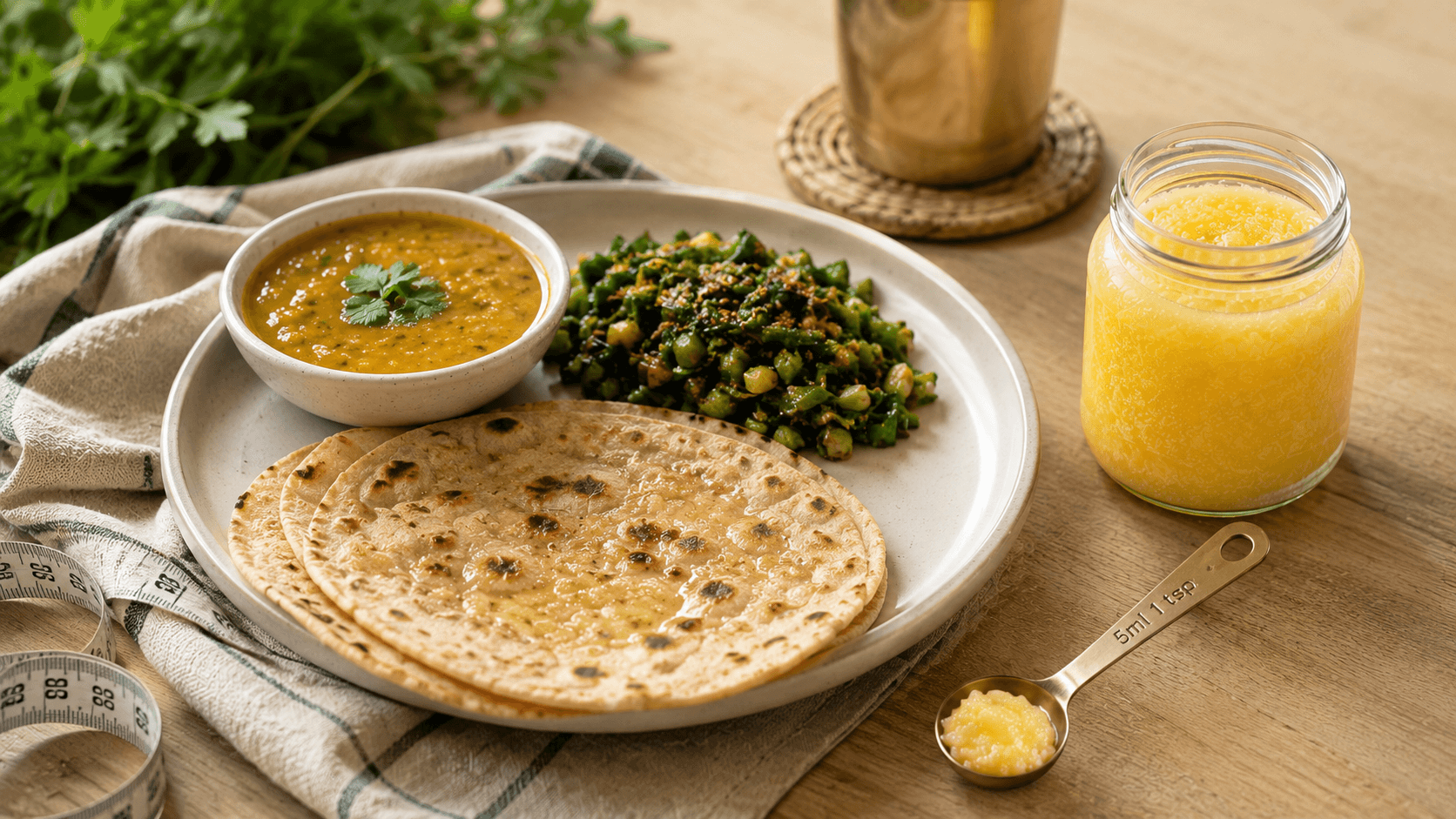
Ghee for Weight Loss: Does It Actually Work?
Search this question and you get two answers, both delivered with total confidence, both wrong. Influencers say ghee melts belly fat. Diet apps tell you to cut it because it is pure fat. Neither holds up. Ghee will not burn a gram off you. Used correctly it still makes losing weight easier, and the reason is unglamorous: appetite.
The Quick Answer
Ghee does not cause weight loss on its own. No single food does. What it does is support the two things that decide whether a diet survives past week three: appetite control and blood-sugar stability. Keep it to 1 to 2 teaspoons a day, replacing your other cooking fats instead of sitting on top of them, and it fits any fat-loss plan. Stack it on top of refined oil and it becomes 45 spare calories a spoon with nothing to show for them.
Popular Claims vs Reality
| What you have heard | Verdict | What actually happens |
|---|---|---|
| "Ghee melts belly fat" | False | No food reduces fat in a chosen area. Fat loss follows a calorie deficit, not a spoon. |
| "Ghee keeps you full for longer" | True | Fat slows gastric emptying, which does reduce snacking between meals. |
| "Ghee makes you fat" | Half true | Only when added on top of existing fats. Swap it in and your calorie total does not move. |
| "Ghee in warm water burns fat in the morning" | Exaggerated | It supports digestion and curbs mid-morning cravings. A real benefit, but an indirect one. |
| "CLA in ghee boosts metabolism" | Overstated | Research on CLA and body fat is mixed at best, and the amount in 1 to 2 tsp is small. |
| "Fat-free is better for weight loss" | False | Very low-fat diets worsen hunger and block absorption of vitamins A, D, E and K. |
How Ghee Genuinely Helps: Four Real Mechanisms
1. It stops the 11 a.m. hunger spiral
This is the biggest practical win, and nobody markets it because it sounds too ordinary. A breakfast with some fat in it digests slowly and holds you. A low-fat, carb-heavy breakfast spikes blood sugar and leaves you hunting for biscuits two hours later. Most diets collapse on snacking, not on meals. That is where a teaspoon of ghee earns its place.
2. It flattens the blood-sugar curve
Add a teaspoon of ghee to a plate of rice or rotis and the glucose releases more slowly, softening the spike-and-crash cycle behind cravings and 3 p.m. fatigue. Ghee itself carries zero carbohydrate.
3. It supports gut health
Ghee is one of the richest natural sources of butyric acid, the short-chain fatty acid that colon cells use as fuel. A healthier gut lining means better digestion and less bloating, which is usually what people are describing when they say they "lost weight" in the first fortnight. That is water and bloat leaving, not fat. Still worth having.
4. It lets you absorb what you are already eating
Eating fewer calories means every nutrient has to count. Vitamins A, D, E and K cannot be absorbed without fat. A little ghee is what turns a plate of salad and sabzi from filling into useful.
How Much Ghee for Weight Loss?
One to two teaspoons a day, counted inside your calorie budget. Learn the arithmetic once and the fear goes away:
- 1 teaspoon ghee is about 5 g and roughly 45 calories. Check the ghee entry in USDA FoodData Central if you want the exact figure.
- 1 tablespoon is about 15 g, so 135 calories.
- A teaspoon of refined oil? Around 40 calories.
Read that last line again, because it is the point most people miss. Swapping oil for ghee is close to calorie-neutral. You are not adding fat to your day, you are upgrading the fat that was already there. ICMR-NIN's Dietary Guidelines for Indians set limits on total visible fat, and those limits cover everything: your ghee, your oil, your butter. For the full age-wise and goal-wise breakdown, see how much ghee per day is safe.
5 Mistakes That Turn Ghee Into Weight Gain
- Stacking instead of swapping. Refined oil in the pan, ghee on the roti, more ghee in the dal. Choose one fat per meal.
- Free-pouring. A generous spoon straight from the jar is often two or three teaspoons. Measure it properly for two weeks and your eye recalibrates for good.
- Treating "ghee is healthy" as a licence. Ghee-loaded halwa is still a sugar problem first.
- Expecting the morning ritual to do the work. A teaspoon in warm water is a good habit. It is not a substitute for a calorie deficit, enough protein and decent sleep.
- Using adulterated ghee, which is the worst of the five. Vanaspati-blended "ghee" hands you industrial trans fats, the one fat category with clearly established harm, and none of the benefits above. Check yours against the signs of fake ghee.
A Simple Day That Works
- Morning: 1 tsp ghee in warm water before anything else. See what 30 days of this ritual does.
- Lunch: spend that day's second teaspoon on the tadka instead of refined oil. Not both.
- Evening: protein-forward meal, no added fat. The budget is spent.
- Skip the reused frying oil, the packaged namkeen, and the extra spoon on the second roti.
That is 90 calories of ghee across a day, replacing roughly the same amount of oil you were using anyway. Nothing has been added to your total.
Where Ghee Cannot Help You
Worth saying plainly, because most articles on this topic will not. Ghee does nothing for you if your calorie total is above your maintenance level. It will not offset a sedentary week. It cannot compensate for four hours of sleep, which raises hunger hormones far more than any fat lowers them. And if you are sensitive to dairy, no purity claim changes that.
Ghee is one supporting piece. Protein, movement and sleep are the plan.
Why the Type of Ghee Changes the Answer
Every benefit listed above assumes the ghee is real. Commercial ghee is typically machine-extracted from cream at high heat, and the cheaper jars are frequently cut with refined oil, vanaspati, colour and essence. That product carries the trans-fat problem and the calories together, with no butyric acid and no fat-soluble vitamins worth counting.
Genuine Bilona ghee takes the slow route. Whole A2 milk is set into curd, hand-churned into makkhan, then simmered on a low flame until the water is gone. That process is the reason real ghee carries the grainy danedar texture and nutty aroma, and the reason the nutrition survives to your kitchen at all. For weight management most people pick Desi Cow A2 Bilona Ghee: lighter, and naturally higher in CLA. If you want the wider comparison of cooking fats, read ghee vs butter vs refined oil.
Frequently Asked Questions
Ghee se weight badhta hai kya?
Not at 1 to 2 teaspoons a day, and not when it replaces the oil you were already cooking in. Weight comes from your daily total, and 45 calories a spoon is a small line item. It becomes a problem only when ghee is added on top of existing fats, or free-poured without measuring.
Does ghee in warm water reduce belly fat?
No. Spot reduction is not how the body works. What the ritual does is improve digestion and cut mid-morning cravings, which supports the deficit that does the real work. Useful, not magic.
Ghee or refined oil if I am trying to lose weight?
Calorie-wise they are nearly identical, so quality and heat stability decide it. Ghee holds up to Indian cooking temperatures and is not chemically extracted, which makes it the better swap at the same calorie cost.
Can I eat ghee at night while dieting?
Yes, if it fits your daily total. Ghee in warm milk at night is a traditional remedy for digestion and sleep, and better sleep genuinely helps weight management. Details in our guide to ghee with warm milk at night.
Cow ghee or buffalo ghee for weight loss?
Cow ghee. It is lighter, slightly less calorie-dense per spoon and higher in CLA. Buffalo ghee suits people trying to gain weight healthily. Full breakdown in our cow ghee vs buffalo ghee comparison.
How long before I see a difference?
Less bloating and fewer cravings usually show up inside two weeks. Real fat loss depends entirely on calorie balance, protein, movement and sleep. Ghee is not the variable that decides it.
Upgrade the Fat, Not the Quantity
You do not need to give up ghee to lose weight. Measure it, swap it for what you were already using, and make sure it is the real thing.
- Lighter, higher in CLA, the weight-management pick: Desi Cow A2 Bilona Ghee (500 ml)
- Denser, for strength and healthy weight gain: Buffalo A2 Bilona Ghee (500 ml)
One ingredient, FSSAI certified, hand-churned in small batches from grass-fed A2 milk in the Chambal valley. Shop the collection → Free shipping on orders above ₹999.
This article is general nutrition information, not medical or dietetic advice. If you have a metabolic, liver or heart condition, ask your doctor before changing your daily fat intake.