

Ghee Massage for Babies: Method, Benefits and What It Cannot Do
In most Indian households the malish is not a decision, it is a routine. Grandmother warms the ghee, the baby goes on a towel on the floor, and twenty minutes later everyone sleeps better. A good part of what this practice is credited with holds up. Two of the biggest claims do not, and one of them is repeated so confidently that it deserves naming early. Ghee massage does not change your baby's complexion.
The Quick Answer
Warm a small amount of pure ghee until it is just liquid, test it on your own inner wrist, and massage with slow gentle strokes for ten to fifteen minutes before the bath. Do it at least forty-five minutes after a feed, never on the face, and patch-test on one small area first. What it reliably gives you is softer skin, a calmer baby and better sleep. What it does not give you is a fairer child, a taller child, or a cure for eczema.
Ghee vs the Usual Alternatives
| Medium | Best for | Watch out for |
|---|---|---|
| Pure ghee | Very dry skin, winter, cold climates. Rich and long-lasting. | Heavy. Can block pores on some babies. Wash off properly. |
| Coconut oil | Summer, humid regions, everyday use. Light and absorbs fast. | Solidifies below about 24°C. Can clog pores on the face. |
| Mustard oil | Traditional in north and east India. Warming in winter. | Strong smell, and it can irritate very sensitive infant skin. |
| Almond oil | Light massage, gentle on most skin. | Nut-derived. Avoid if there is any family history of nut allergy. |
| Olive oil | Widely used, easy to find. | Some evidence it can weaken the skin barrier in infants. Not our first pick. |
Season matters more than brand loyalty. Many families use ghee through winter and switch to coconut oil in summer, which is a sensible approach.
The Method, Step by Step
- Pick the time. Mid-morning or early evening, before the bath. Wait at least forty-five minutes after a feed, because pressure on a full stomach causes reflux and spit-up.
- Warm the room, not just the ghee. A warm draught-free room matters more than most people realise, since babies lose heat quickly when undressed.
- Warm the ghee gently. A small bowl placed in warm water is enough. Never heat it directly on a flame for this, and never in a microwave, which creates hot spots.
- Test it on your own inner wrist. It should feel comfortably warm, not hot. Your baby's skin is thinner than yours and burns at a lower temperature.
- Patch test the first time. A little on the inside of one leg, then wait a day and check for redness before doing a full massage.
- Massage in order: legs and feet, arms and hands, chest, tummy, back, then a light touch on the scalp. Slow strokes moving outward from the centre. On the tummy, clockwise only, and very lightly.
- Ten to fifteen minutes is plenty. Stop earlier if your baby is fussing. This is meant to be pleasant, not a routine to complete.
- Bathe afterwards with a mild cleanser. Ghee is rich, and leaving a thick layer on overnight tends to block pores.
What It Genuinely Does
It calms the baby, and that is the biggest effect
The strongest thing about infant massage is the massage. Research on infant massage has looked at sleep, crying, bonding and weight gain, with the more convincing findings in preterm infants. Note carefully what that means: the evidence is about structured touch, not about ghee specifically. Skin-to-skin contact and rhythmic pressure are doing most of the work.
It moisturises well
Ghee is nearly pure fat with no water, which makes it a strong occlusive. It sits on the surface and slows water loss, which is exactly what dry infant skin needs. Emollient use and the neonatal skin barrier is an active research area, and richer emollients suit dry skin and cold weather particularly well.
It helps sleep, and it helps you
A warm massage followed by a bath and a feed is a strong wind-down sequence, and most parents notice longer stretches of sleep. The routine itself is doing much of this. That does not make it less useful.
It is a genuine Ayurvedic practice
Abhyanga, oil or ghee massage, is documented in classical Ayurvedic texts, and ghrita-based preparations remain part of the formulations recognised by the Ministry of Ayush . For infants it is described as grounding and vata-pacifying, which in practical terms maps onto a settled, less fretful baby.
Safety Rules That Are Not Optional
- Never on the face. Ghee near the eyes, nose or mouth risks irritation, and oil entering the airway is a real hazard.
- Nothing in the nostrils or ears. Nasya is a practitioner-guided procedure for adults, not something to try on an infant from a video.
- Stop for any rash, redness or bumps. Ghee is moderately comedogenic and some babies develop blocked pores or milia.
- Skip the massage entirely if your baby has a fever, a skin infection, an open wound, or has just had a vaccination in the last day.
- Never massage a baby who is crying hard or has just fed.
- Support the head and neck at all times, and keep pressure very light. Feather-light is correct for a newborn.
- Ghee makes hands and babies slippery. Massage on a towel on the floor, never on a bed or table edge.
- If your baby has eczema or diagnosed dairy allergy, ask your pediatrician before using ghee on the skin at all.
The Two Claims That Are Not True
Ghee massage does not lighten your baby's complexion. There is no mechanism and no evidence. Skin colour is genetic. This claim is common in India, it is used to sell products, and it carries a harm beyond the wasted money: it teaches a family to look for a problem where none exists. Any brand or advisor making it has told you something useful about their reliability.
It does not straighten legs, cure eczema or make a baby taller. Bowed legs in infancy usually resolve on their own and sometimes signal a vitamin D issue that needs a doctor, not a massage. Eczema needs medical treatment, and a rich occlusive can make some cases worse. Height is genetics and overall nutrition.
And to repeat the honest version of the benefits: most of what massage delivers comes from the touch and the routine. Ghee is a good medium for it, especially in winter. It is not a treatment.
How Much Ghee, and How Often
Daily is fine for most babies, once a day, before the bath. In peak summer or humid weather, switch to something lighter or reduce to a few times a week, because a heavy occlusive plus heat leads to prickly heat and blocked pores.
Quantity is small. A teaspoon or two covers a newborn. If your baby still feels greasy after the bath, you used too much.
The Ghee You Rub In Should Be Food-Grade Pure
This is the part that gets skipped. Parents who read every label on the ghee they feed their baby will happily massage with whatever tin is cheapest.
Skin absorbs, and you are leaving this on for twenty minutes across a large surface area. Adulterated ghee cut with refined oil, vanaspati, artificial colour or essence has no place on an infant. India's food safety regulations require the label to declare what is in the pack, so use the same standard you would for feeding. Our guide on choosing ghee for babies covers the checklist, and the signs of fake ghee covers testing a jar you already own.
Real Bilona ghee is whole A2 milk set into curd, hand-churned into makkhan, then simmered on a low flame. One ingredient. That is the method behind the word bilona , and it is why the ghee comes out grainy and smells nutty.
Frequently Asked Questions
Bacche ko ghee ki malish kaise kare?
Thoda ghee halka garam karein, apni kalai par lagaakar temperature check karein, phir dheere dheere malish karein: pehle pair, phir haath, seena, pet, peeth aur sabse aakhir mein halke se sir. Pet par sirf clockwise aur bahut halka. Dus se pandrah minute kaafi hai. Doodh pilane ke kam se kam pauna ghanta baad karein, aur baad mein nahla dein. Chehre par kabhi na lagayein.
Baby massage ke liye ghee ya tel, kaunsa behtar hai?
Mausam par nirbhar karta hai. Sardi mein ghee behtar hai kyunki wo bhaari hai aur rookhi twacha ke liye zyada asardar. Garmi aur humid mausam mein nariyal tel halka padta hai aur jaldi soakh jaata hai. Bahut se parivaar sardi mein ghee aur garmi mein nariyal tel istemal karte hain, aur ye samajhdari hai.
Ghee malish se bacche ka rang gora hota hai kya?
Nahi. Iska koi vaigyanik aadhar nahi hai, aur rang genetics se tay hota hai. Jo bhi ye daawa karta hai, uski baaki salaah par bhi bharosa mat kijiye. Malish ke asli fayde hain narm twacha, shaant bacha aur behtar neend.
Can I massage a newborn with ghee?
Many families begin in the first weeks, with feather-light pressure and a patch test first. For a premature baby, a baby with jaundice under treatment, or any diagnosed skin condition, ask your pediatrician before starting.
Should I leave the ghee on overnight?
No. Bathe your baby after the massage. Ghee is rich and moderately comedogenic, and leaving a thick layer on overnight tends to cause blocked pores and prickly heat.
How is this different from eating ghee?
Different route, different benefits. Eating ghee supports brain development, digestion and healthy weight gain from the inside, with age-wise amounts in our guide to ghee for babies . Massage works on the skin barrier, sleep and calm. Doing one does not replace the other.
One Jar for Both
The same standard applies whether it goes in the khichdi or on the skin: one ingredient, nothing added.
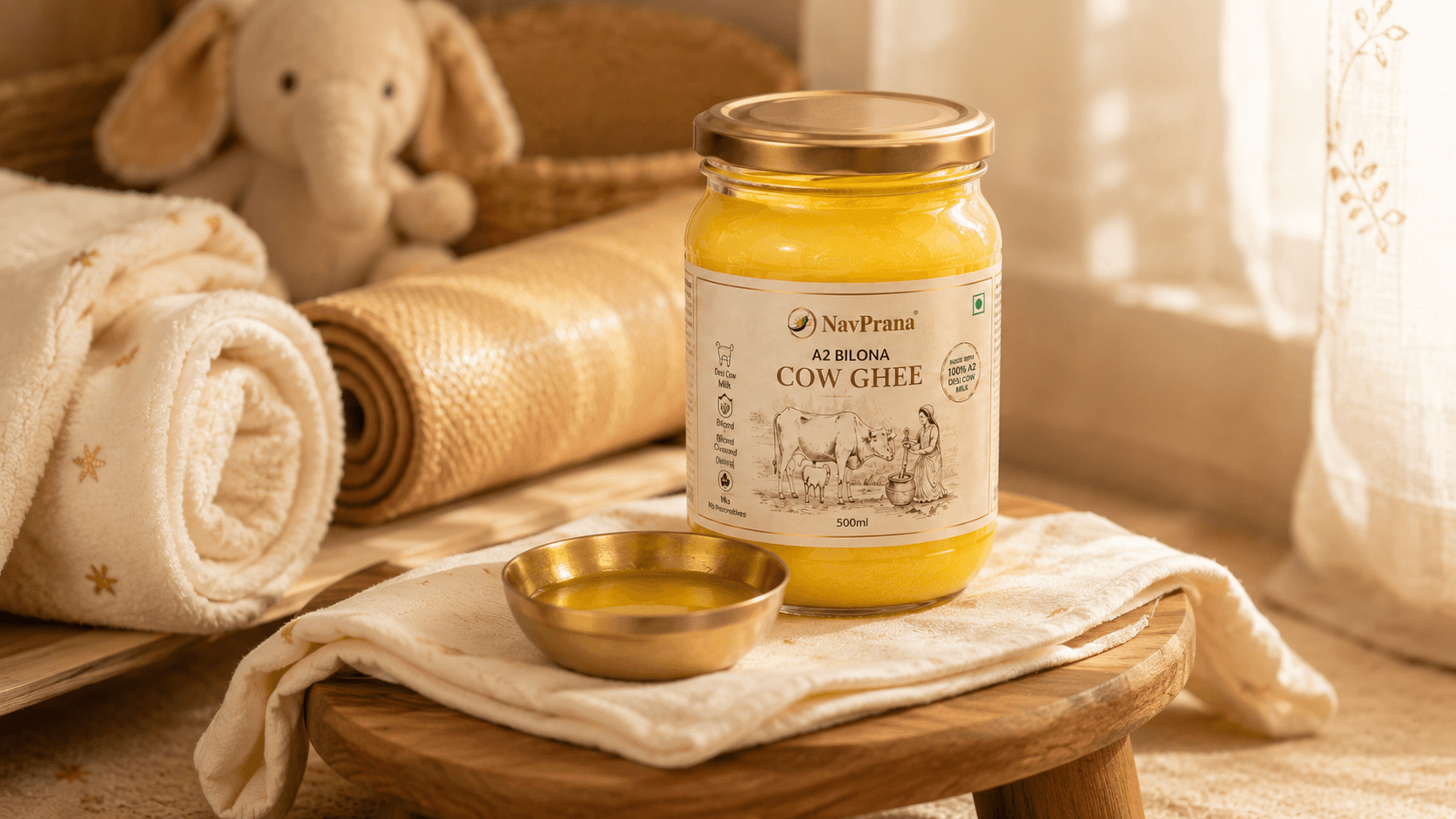
- Lighter, and the usual choice for feeding too: Desi Cow A2 Bilona Ghee (500 ml)
- Richer and denser, favoured for winter malish: Buffalo A2 Bilona Ghee (500 ml)
Hand-churned in small batches from grass-fed A2 milk, FSSAI certified, in glass. Shop the collection → Free shipping on orders above ₹999.
NavPrana ghee is a food product, not a certified cosmetic or baby-care product, and we make no cosmetic claims for it. This article describes a traditional practice and general skin-care principles, not medical advice. Speak to your pediatrician before starting massage with a premature baby or one with eczema, jaundice or any diagnosed condition, and stop immediately if any reaction appears.