

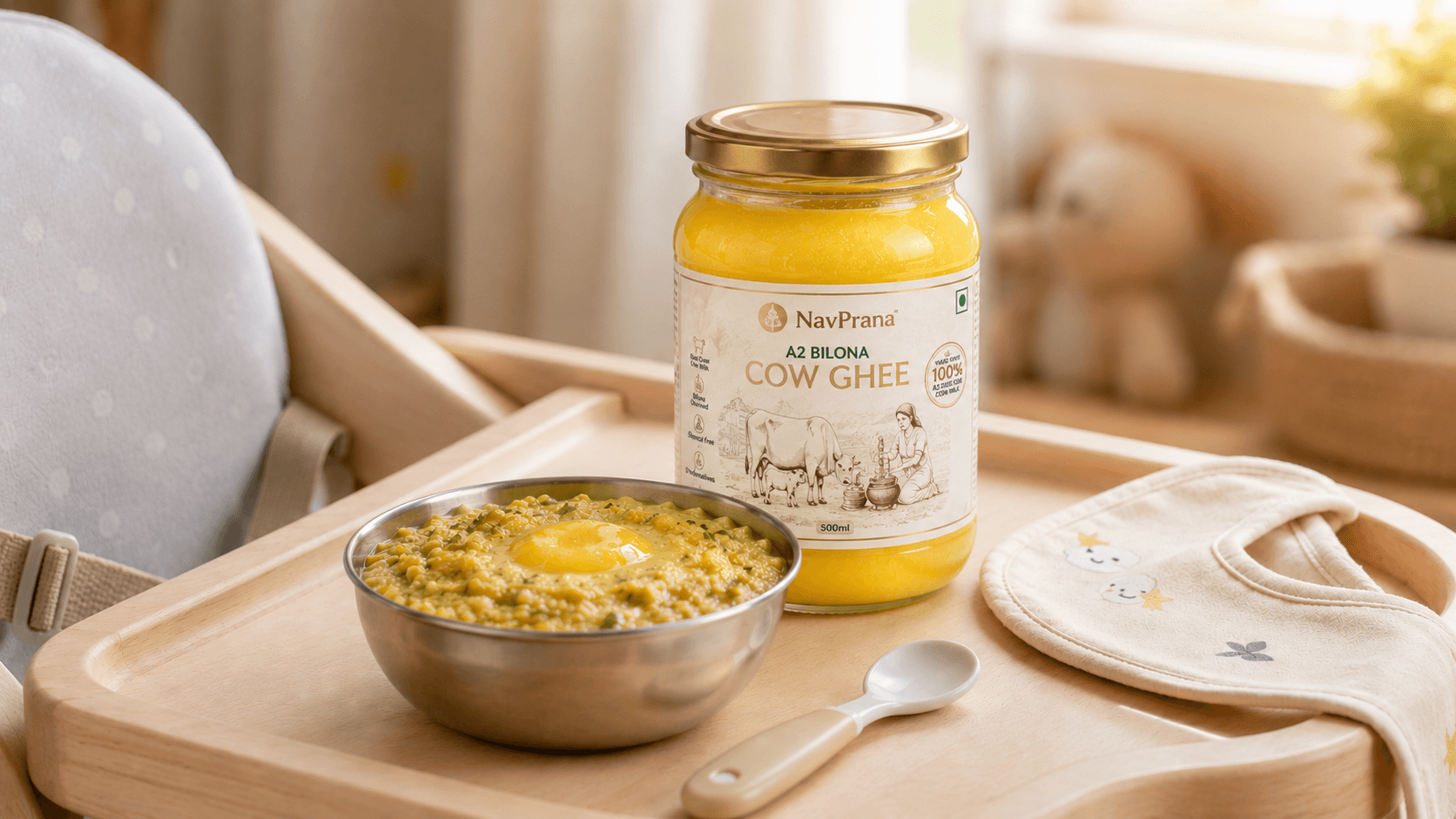
Best Ghee for Babies: How to Choose It, and What to Avoid
Most grocery decisions do not matter very much. This one does. A six-month-old's liver and gut cannot process what yours can , and ghee is likely to be the first fat your baby ever eats, in a small amount, every single day, for years. Adulterated ghee that would give you mild indigestion is a different proposition entirely for a body that weighs seven kilograms. Here is what to check, in order.
The Quick Answer
Look for one ingredient on the label, made by the bilona method from A2 milk, in glass, with an FSSAI licence number printed on the jar. Reject anything listing refined oil, vanaspati, artificial colour or flavour. Cow ghee is the usual first choice because it is lighter; buffalo ghee suits babies who need to gain weight. And ignore the phrase baby ghee entirely, because no such grade exists in Indian law.
What to Check, and Why It Matters More for a Baby
| Check | What you want | Why it matters more for an infant |
|---|---|---|
| Ingredient list | One ingredient only | An infant liver processes additives far less efficiently than an adult's |
| No vanaspati or refined oil | Absent entirely | Vanaspati means trans fat, during the fastest brain growth of your child's life |
| Method | Curd-churned (bilona), stated plainly | Low, slow heat preserves butyric acid and vitamins A, D, E, K |
| Milk source | A2, grass-fed, named region | A2 protein is gentler on a developing gut than A1 |
| Texture | Grainy danedar | The simplest visual sign the fat was not rushed or blended |
| Packaging | Glass, sealed | Less oxidation, and no leaching questions from thin plastic |
| FSSAI licence | Number printed on the jar | Basic accountability. Loose or unbranded ghee has none. |
The Five Things to Reject Outright
- Vanaspati or hydrogenated fat. This is the one that genuinely worries us. Vanaspati carries industrial trans fat , which the WHO identifies as the fat category with clearly established harm, and it is a common adulterant in cheap ghee.
- Refined vegetable oil blends. Often listed quietly, sometimes only implied by the word blended. India's food safety regulations require the label to declare what is in the pack, so read it rather than the front-of-jar claims.
- Artificial colour or added flavour. Real ghee needs neither. Cow ghee is golden from beta-carotene, not from tartrazine.
- Loose or unbranded ghee. No label, no licence, no traceability, no recourse. Fine for an adult taking a risk knowingly. Not for a baby.
- Anything sold as ghee-based, table spread, or a ghee substitute. These are different products with different rules.
Cow or Buffalo Ghee for a Baby?
Both are safe after six months. The difference is density.
Cow ghee is lighter and easier on a new digestive system, which makes it the standard first choice when solids begin. Buffalo ghee carries more calories per spoon, which helps babies who are underweight or slow to gain. Many families keep cow ghee for daily khichdi and use buffalo ghee during winter or a growth spurt. The full comparison is in our cow ghee vs buffalo ghee guide , and if weight is the concern, this guide on gaining weight with ghee has the age-wise amounts.
There Is No Such Thing as Baby Ghee
This section will cost us sales and it is still worth writing.
Some brands sell a jar labelled baby ghee or infant ghee at a premium over their regular ghee. India has no separate legal grade for infant ghee. FSSAI defines a compositional standard for ghee, full stop. There is no infant category, no additional testing requirement, and no certification behind the word baby on a label.
So in almost every case you are paying extra for smaller packaging and a picture of an infant. If a brand's regular ghee is pure, single-ingredient and bilona-made, it is already the right ghee for your baby. If it is not, a baby label does not fix it.
The one legitimate reason to buy a smaller jar is genuine: a baby uses very little, and a smaller jar finishes before the ghee ages. Buy the small size for that reason, not for the label. Our guide on how much ghee a household actually uses covers sizing.
When to Start, and How Much
The WHO recommends starting complementary foods at around six months alongside continued breastfeeding, and ghee fits naturally into those first foods. Begin with two or three drops stirred into cooled dal or khichdi.
We have a full age-by-age chart rather than repeating it here: see ghee for babies, when to start and how much . Speak to your pediatrician first if there is a family history of milk allergy.
How to Check the Jar You Already Own
- Look at it cold. Real bilona ghee sets grainy. Perfectly smooth and uniform ghee in an Indian winter deserves a second look.
- Smell it. Nutty and warm is right. Flat, sharp, or faintly chemical is not.
- Melt a little in your palm. Pure ghee melts quickly from body heat alone.
- Run the official tests. FSSAI publishes a free booklet of rapid at-home adulteration tests , and our own guide covers the signs of fake ghee .
And if the jar has turned grainy or hard in winter, that is not spoilage. Here is why graininess is a good sign.
What Ghee Will Not Do for Your Baby
Parenting content in India tends to oversell this, so plainly.
Ghee will not make your baby fairer. That claim has no basis and it should make you distrust everything else the source says. It will not on its own make a baby taller, and it will not raise IQ. Fat is structurally important for brain development, which is a real and well-established point, but no single food produces a measurable jump in intelligence.
Ghee is also not essential. Babies grow well on a variety of fat sources, and if your child has a diagnosed milk protein allergy your pediatrician may keep ghee out entirely. It is a good first fat, not a required one.
Finally, more is not better. Excess ghee in a small stomach displaces the protein, iron and variety a baby needs, and causes loose stools. Stay inside the age-appropriate amounts.
Why We Make It the Slow Way
Every check on this page comes down to one thing: how much the fat was interfered with. Machine ghee is extracted from cream at high heat in minutes. The Bilona method takes hours: whole A2 milk set into curd, hand-churned into makkhan, then simmered on a low flame until the water leaves and the milk solids separate out. That is what preserves butyric acid, the fat-soluble vitamins and the grainy texture, and it is also what removes nearly all the lactose and casein. Our guide to what bilona actually means explains the four steps, including the fact that the word itself is not legally protected in India.
Frequently Asked Questions
Bacho ke liye kaunsa ghee accha hai?
Wo jisme sirf ek cheez ho, aur kuch nahi. Label par refined oil, vanaspati, colour ya flavour ka naam bilkul nahi hona chahiye. Bilona tareeke se bana A2 ghee sabse behtar hai, shishe ke jar mein, FSSAI licence number ke saath. Shuruaat ke liye gaay ka ghee halka hota hai; agar bacche ka weight kam hai to bhains ka ghee zyada calorie deta hai.
Baby ghee alag hota hai kya, mehnga wala lena chahiye?
Nahi. Bharat mein bacchon ke liye ghee ka koi alag legal grade nahi hai. Jo brand baby ghee likh kar zyada paisa leta hai, wo usually wahi ghee chhote packet mein bech raha hai. Agar unka normal ghee shudh hai to wahi bacche ke liye sahi hai. Chhota pack lena theek hai, par isliye ki jaldi khatam ho jaye, label ki wajah se nahi.
Bacche ko ghee lagane se rang saaf hota hai kya?
Nahi, iska koi aadhar nahi hai. Bacche ka rang genetics se tay hota hai. Jo brand ya salaah ye daawa kare, uski baaki baaton par bhi bharosa mat karein.
Is A2 ghee necessary for babies, or is regular pure ghee fine?
Pure ghee made properly is the main requirement. A2 is a reasonable preference, since A2 protein is generally described as gentler on digestion, and in practice an A2 claim usually signals indigenous breeds and smaller herds. Just note that ghee has most of its protein removed during clarification, so the A2 argument matters less here than in milk. We explain that in our A2 vs A1 guide .
My baby is lactose intolerant. Can I still use ghee?
Usually yes, because clarification removes nearly all the lactose and casein. For a diagnosed cow milk protein allergy, ask your pediatrician before introducing it. Do not decide this from an article.
Can I use the same ghee for my baby and for cooking?
Yes, and you should. If a jar is pure enough for your baby it is good for the whole family, and one jar finishing faster is better than a baby jar sitting open for months.
The Purest Start You Can Buy
One ingredient. Curd-churned by hand in small batches. Grass-fed A2 milk from the Chambal valley. FSSAI certified, in glass.
- Lighter, the usual first choice when solids begin: Desi Cow A2 Bilona Ghee (500 ml)
- Denser, for babies who need to gain weight: Buffalo A2 Bilona Ghee (500 ml)
Start with the 500 ml. A baby uses very little, and a jar that finishes sooner is fresher throughout. Shop the collection → Free shipping on orders above ₹999.
This article is general information for parents, not medical advice. Introduce any new food to your baby only after speaking with your pediatrician, particularly if there is a family history of allergy, if your baby was premature, or if your baby has a diagnosed condition.