

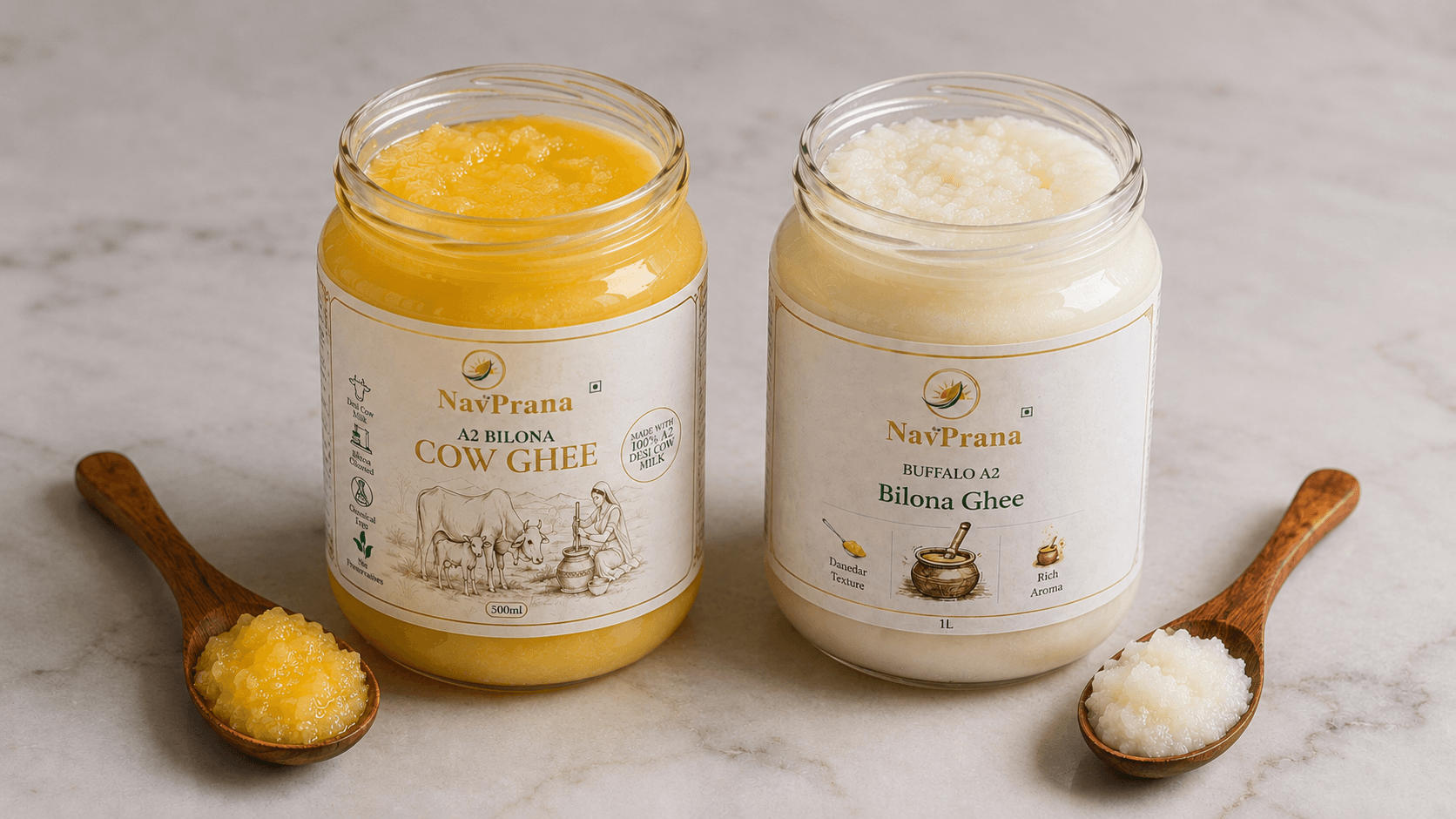
Why Is Buffalo Ghee White?
You ordered buffalo ghee, opened the jar, and found something closer to the colour of fresh cream than the deep golden yellow you were expecting. First thought, for most people: this is fake. It is not. White is the correct colour for buffalo ghee, and the reason comes down to a difference in how the two animals handle a single pigment. Once you know it, you will also understand why colour is one of the least reliable purity tests there is.
The Quick Answer
Buffalo ghee is white because buffalo milk contains almost no beta-carotene. Buffaloes convert the carotene they eat from green fodder into colourless vitamin A almost completely. Cows do not; they pass a good amount of it through into their milk fat, and beta-carotene is an orange-yellow pigment. So cow ghee is golden and buffalo ghee is creamy white, from exactly the same quality of milk and the same process. Colour tells you which animal it came from. It tells you very little about purity.
What the Colour Actually Means
| What you see | What it means | Verdict |
|---|---|---|
| Creamy white to off-white | Buffalo ghee, normal | Correct. Expected. |
| Golden yellow | Cow ghee with natural beta-carotene, usually grazed | Correct for cow ghee |
| Pale straw | Cow ghee from stall-fed animals, or a winter batch | Normal. Feed and season shift this. |
| Bright, uniform, almost neon yellow | Often added colour | Red flag |
| Yellow buffalo ghee | Buffalo fat does not do this naturally | Red flag. Suspect colour or blending. |
| Any colour, perfectly smooth | Likely machine-extracted or blended | Check texture and aroma |
The Mechanism, Briefly
Green fodder contains beta-carotene, which the body uses to make vitamin A. The difference between the two species is in the conversion.
A buffalo converts carotene into retinol, the active form of vitamin A, very efficiently. Almost nothing survives as pigment, so the fat comes out pale. A cow converts less and deposits the remainder in its milk fat, where the pigment stays visible. Research on carotene in buffalo and cow milk fat covers this, and it is why the colour difference is consistent regardless of brand.
Note what this does not mean. Buffalo ghee is not short on vitamin A. The vitamin is there, already converted. It just is not carrying the pigment along with it. Buffalo milk also runs higher in total fat than cow milk, along with other compositional differences , which is why buffalo ghee feels denser on the spoon.
Why Colour Is a Poor Purity Test
Most Indian buyers grew up with the rule that golden means pure. It is a bad rule in both directions.
- Colour varies with the animal. Cow golden, buffalo white. Judging buffalo ghee against a cow ghee standard is judging the wrong thing.
- Colour varies with feed and season. The same herd produces deeper yellow ghee when grazing fresh green fodder and paler ghee on dry feed in summer. Nothing about purity changed.
- Colour is the easiest thing to fake. A pinch of permitted or unpermitted colourant turns pale blended fat into a convincing golden. Adulterators know exactly what buyers look for.
So the pigment that reassures you is also the pigment that is cheapest to add. That is a bad combination for a purity test.
When Yellow Is the Actual Red Flag
Here is the inversion worth remembering. Yellow buffalo ghee is a genuine warning sign.
Buffalo fat does not produce that colour on its own. If a jar sold as buffalo ghee looks golden, one of a few things has happened: colour was added, cow ghee was blended in, or something else entirely is in the jar. India's food safety regulations require the label to declare added colour, so read the ingredient list. One ingredient, or put it back.
Bright uniform yellow in cow ghee deserves a look too. Natural carotene gives an uneven, warm gold that varies between batches. A flat, identical, slightly fluorescent yellow across every jar on the shelf is a manufacturing decision, not a farming outcome.
What to Check Instead of Colour
- Texture. Real bilona ghee sets grainy, the danedar crystalline look. Buffalo ghee grains more readily than cow ghee. Perfectly smooth ghee in an Indian winter is the thing to question.
- Aroma. Warm, nutty, faintly caramelised. Flat or vaguely chemical means it was rushed or cut.
- Melt. Pure ghee liquefies quickly from the heat of your palm.
- The label. One ingredient. No refined oil, no vanaspati, no colour, no essence.
- The price arithmetic. If a litre costs less than the milk needed to make it, the milk is not in there. Our seven checks before you buy walks through the sum.
For the official versions, FSSAI publishes a free booklet of rapid at-home adulteration tests , and our own guide covers the signs of fake ghee .
Do Not Over-Read Colour in the Other Direction Either
Having argued that white is fine, the fair version cuts both ways. White does not prove purity any more than gold does. Blended and machine-made buffalo ghee is also white. A pale jar can still be cut with refined oil, and refined oil is close to colourless, which makes it easier to hide in buffalo ghee than in cow ghee.
So the honest summary is that colour is close to useless as a test, whichever colour you are looking at. Use it only to confirm the species matches the label. Then judge the jar on texture, aroma, ingredients and price.
Since You Have Buffalo Ghee, Here Is What It Is Good At
Buffalo ghee is denser and higher in calories per spoon than cow ghee, which makes it the traditional pick for a few specific jobs:
- Sweets and frying. Halwais have used buffalo ghee for generations for the mouthfeel it gives halwa, laddoo and barfi.
- Children and anyone gaining weight. More energy in the same spoon. See how to use ghee for weight gain .
- Winter and night milk. Grounding and rich. The night milk routine covers the method.
- Postpartum recovery, in panjiri and gond ke laddoo.
If you were choosing between the two and got here by accident, the full breakdown is in our cow ghee vs buffalo ghee comparison .
Why Our Buffalo Ghee Stays White
Because we do not add anything to it. Whole A2 buffalo milk set into curd, hand-churned into makkhan, then simmered on a low flame until the water leaves and the milk solids separate out. That is the bilona method , and it produces creamy white ghee with a strong nutty aroma and a pronounced grain, every batch. If it ever came out golden, something would have gone wrong.
Frequently Asked Questions
Bhains ka ghee safed kyun hota hai?
Kyunki bhains ke doodh mein beta-carotene lagbhag nahi hota. Bhains hare chaare se mile carotene ko poori tarah vitamin A mein badal deti hai, aur vitamin A ka koi rang nahi hota. Gaay ye badlaav kam karti hai, isliye bacha hua peela pigment uske ghee mein dikh jaata hai. Matlab safed rang bhains ke ghee ka sahi rang hai, milawat ki nishani nahi.
Safed ghee asli hota hai kya?
Haan, agar wo bhains ka ghee hai. Bhains ka asli ghee safed ya cream jaisa hi hota hai. Rang dekh kar shuddhata ka faisla mat karein, kyunki rang milana sabse aasan cheez hai. Iski jagah daanedaar texture, nutty khushbu, ek hi ingredient wala label, aur keemat ka hisaab dekhein.
Peela ghee accha ya safed?
Dono theek hain, bas alag jaanwar ka hai. Gaay ka ghee peela, bhains ka safed. Chinta ki baat tab hai jab bhains ka ghee peela dikhe, kyunki bhains ki charbi apne aap peeli nahi hoti. Uska matlab colour milaya gaya hai ya kuch aur milaya gaya hai.
Does white buffalo ghee have less vitamin A?
No. The vitamin A is present, already converted from carotene by the animal. What is missing is the orange pigment, not the vitamin. Cow ghee carries beta-carotene, which your body then converts. Different route, both useful.
My cow ghee looks paler this month. Is something wrong?
Almost certainly not. Carotene levels rise when animals graze fresh green fodder and fall on dry feed, so cow ghee runs deeper gold in some seasons and paler in others. Batch-to-batch variation is a sign that nothing is being standardised with additives.
Can I tell adulterated ghee by colour alone?
No, and this is the main point of the article. Refined oil is nearly colourless and hides more easily in white buffalo ghee than in golden cow ghee. Colour only confirms the species. Texture, aroma, the ingredient list and price arithmetic do the real work.
White, Grainy, One Ingredient
That is what buffalo ghee is supposed to look like.
- Creamy white and dense, for sweets, frying and winter: Buffalo A2 Bilona Ghee (500 ml) or the 1 litre
- Golden and lighter, for daily cooking: Desi Cow A2 Bilona Ghee (500 ml)
No colour, no essence, nothing added. Hand-churned in small batches from grass-fed A2 milk in the Chambal valley, FSSAI certified. Shop the collection → Free shipping on orders above ₹999.
General consumer information, not a laboratory method. If you suspect a product is adulterated, report it to FSSAI rather than relying on visual checks alone.