

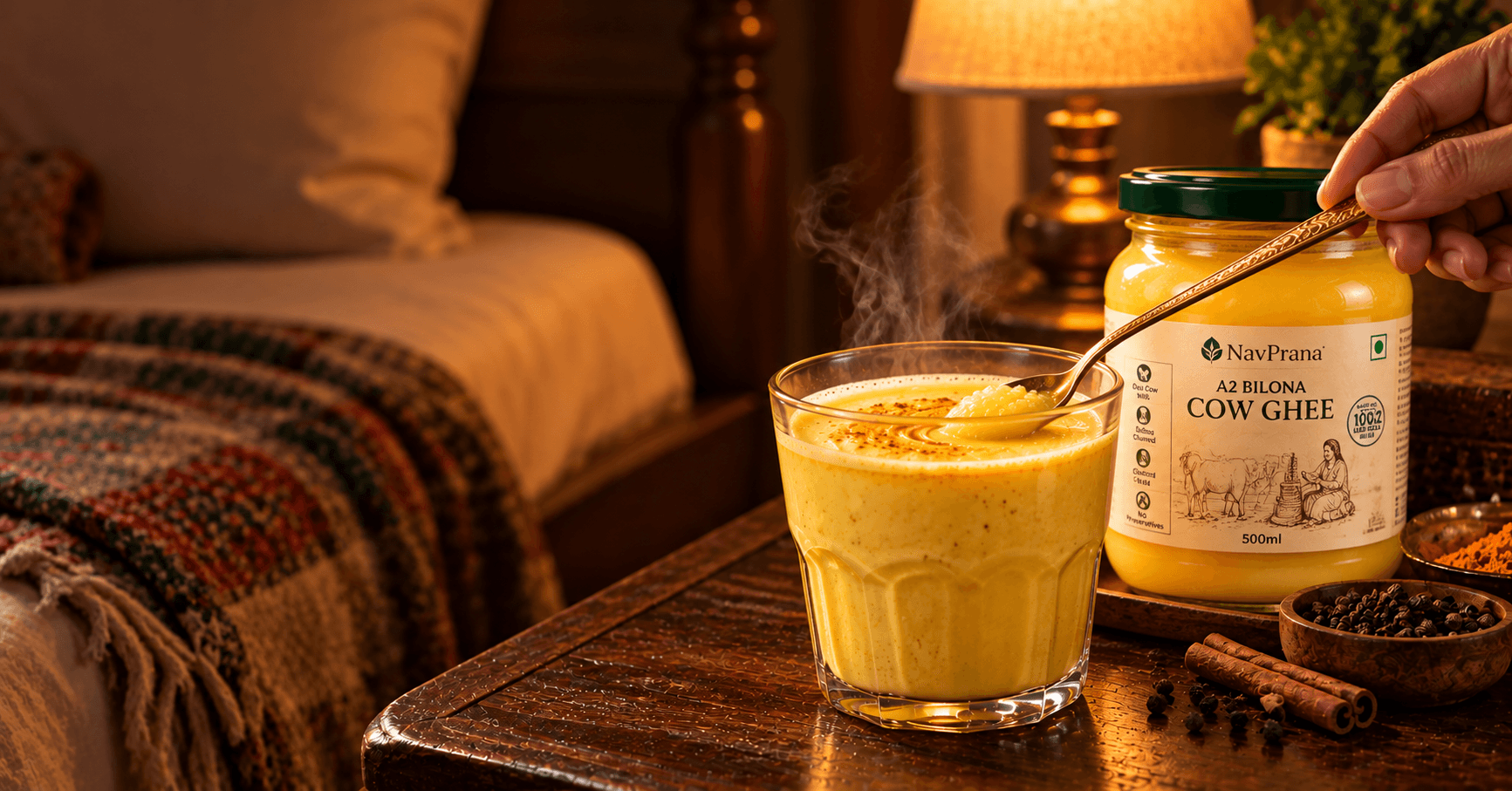
The cough starts, and the ghee jar disappears from the table. "No ghee, it makes the balgam worse." Then your grandmother walks in with a glass of haldi doodh with a spoon of ghee in it. Both cannot be right. So, does ghee cause cough? Short version: no. The longer version explains why your family still argues about it.
Quick Answer
Ghee does not cause a cough. Coughs come from infections, allergies, smoke and other irritants, not from a spoon of ghee. A 2005 review of the research found no evidence that milk increases mucus. Ayurveda does describe ghee as heavy and, in general, as raising kapha, which is why many families cut back during a wet, phlegmy cough. A small amount in warm food is fine for most people.
Ghee During a Cough: A Practical Guide
| Situation | Ghee? | Why |
|---|---|---|
| Dry, tickly cough | Yes, a little, in warm food or haldi doodh | Warm food is comforting, and there is no reason to stop. |
| Wet cough with a lot of phlegm | Keep it small; skip heavy, fried food | Ayurveda treats ghee as heavy and kapha-raising in excess. |
| Cough with fever, little appetite | Whatever they can eat; light food first | Eating at all matters more than the fat in it. |
| Child with a cough | Normal amounts in normal food | No need to stop. No honey under age 1. |
| Cough lasting more than 3 weeks | Not the question to ask | See a doctor. |
Where the "Ghee Causes Cough" Idea Comes From
Ayurveda: heavy, cooling, kapha
Ayurveda groups the body's tendencies into three doshas: vata, pitta and kapha. Kapha governs heaviness, moisture and mucus. A 2024 review of the classical texts in the Journal of Ayurveda and Integrative Medicine sets out how each type of ghee is classified, and ghee in general is listed as heavy, cooling and kapha-raising. So when there is already a lot of kapha, as in a chesty, phlegmy cough, the traditional advice is to go easy on heavy food, ghee included.
The same table rates cow ghee differently. Several classical texts list it as lowering kapha. That is why the same tradition also puts ghee into remedies for a cold.
The fridge and the frying pan
Plenty of people blame ghee for what was really cold food from the fridge, or a plate of pakoras fried in whatever fat the shop uses. The cough came first. The ghee got blamed.
What the Research Says About Dairy and Mucus
The belief that dairy thickens phlegm is old and widespread, so researchers have tested it. A 2005 review in the Journal of the American College of Nutrition concluded that milk consumption does not lead to mucus production or asthma. Some people feel their throat is coated after milk. That feeling is real. Extra mucus was not found.
Ghee is even further from that question than milk. It is almost pure fat: the milk protein and sugar are mostly removed when the butter is simmered.
How Families Traditionally Use Ghee for a Cold
- Haldi doodh with half a teaspoon of ghee at night. Our post on ghee with warm milk at night covers it.
- A pinch of black pepper and mishri in a little warm ghee, licked off a spoon. This one is common in North Indian homes.
- Khichdi or dal with a spoon of ghee on top: light, warm, easy to eat when appetite is low.
These are traditions, not treatments. The NHS lists hot lemon and honey as something to try for a cough while noting the evidence is limited, and honey must never be given to babies under one year old.
What Ghee Will Not Do
Ghee will not cure a cough. It will not kill a virus, clear a chest infection, or replace any medicine a doctor gives. If a jar of ghee is being sold to you as a cough remedy, that is marketing.
When to See a Doctor
Following the NHS guidance on coughs, see a doctor if:
- the cough has lasted more than three weeks;
- you are losing weight for no reason, or your immunity is weak;
- the cough is very bad or getting worse quickly, or there is chest pain;
- you are coughing up blood or struggling to breathe. That is urgent.
For babies and children, the NHS has separate guidance on coughs and colds. When in doubt with a small child, call the doctor.
Pure Ghee Matters More When You Are Unwell
If you are going to eat ghee while you recover, make it the real thing, not a blend padded with vanaspati. Ours is made by the bilona method in the Chambal valley: curd churned by hand, butter slow-simmered, nothing added. The method is explained in what is bilona ghee, and our ghee in winter guide covers the rest of the season.
Frequently Asked Questions
Does ghee increase cough?
No. There is no evidence that ghee makes a cough worse. Ayurveda advises going easy on heavy food, including ghee, during a wet, phlegmy cough, so keep amounts small then.
Is ghee good for dry cough?
A little ghee in warm food or haldi doodh is a common home tradition for a dry cough. It may feel soothing. It does not treat the cause.
Khansi me ghee khana chahiye ya nahi?
Haan, thoda ghee garam khane ya haldi doodh me le sakte hain. Ghee se khansi nahi hoti. Bas balgam wali khansi me bhaari aur tala hua khana kam rakhein. Khansi 3 hafte se zyada chale to doctor ko dikhayein.
Can I give ghee to a child with a cough?
Yes, in the normal amount they already eat in food. There is no need to stop. Never give honey to a baby under one, and see the doctor if a small child's cough worries you. Our ghee for babies guide has age-wise amounts.
Is cow ghee or buffalo ghee better during a cough?
Cow ghee. It is the lighter of the two, which suits a stomach that is already off its appetite.
Keep Real Ghee in the Kitchen This Winter
For haldi doodh, khichdi and everyday dal, A2 Desi Cow Bilona Ghee is the one to keep. For winter laddoo and halwa, A2 Buffalo Bilona Ghee. Shipping is free on orders above ₹599.
This article is general information, not medical advice. A cough with breathlessness, chest pain, blood, high fever or that lasts more than three weeks needs a doctor.