

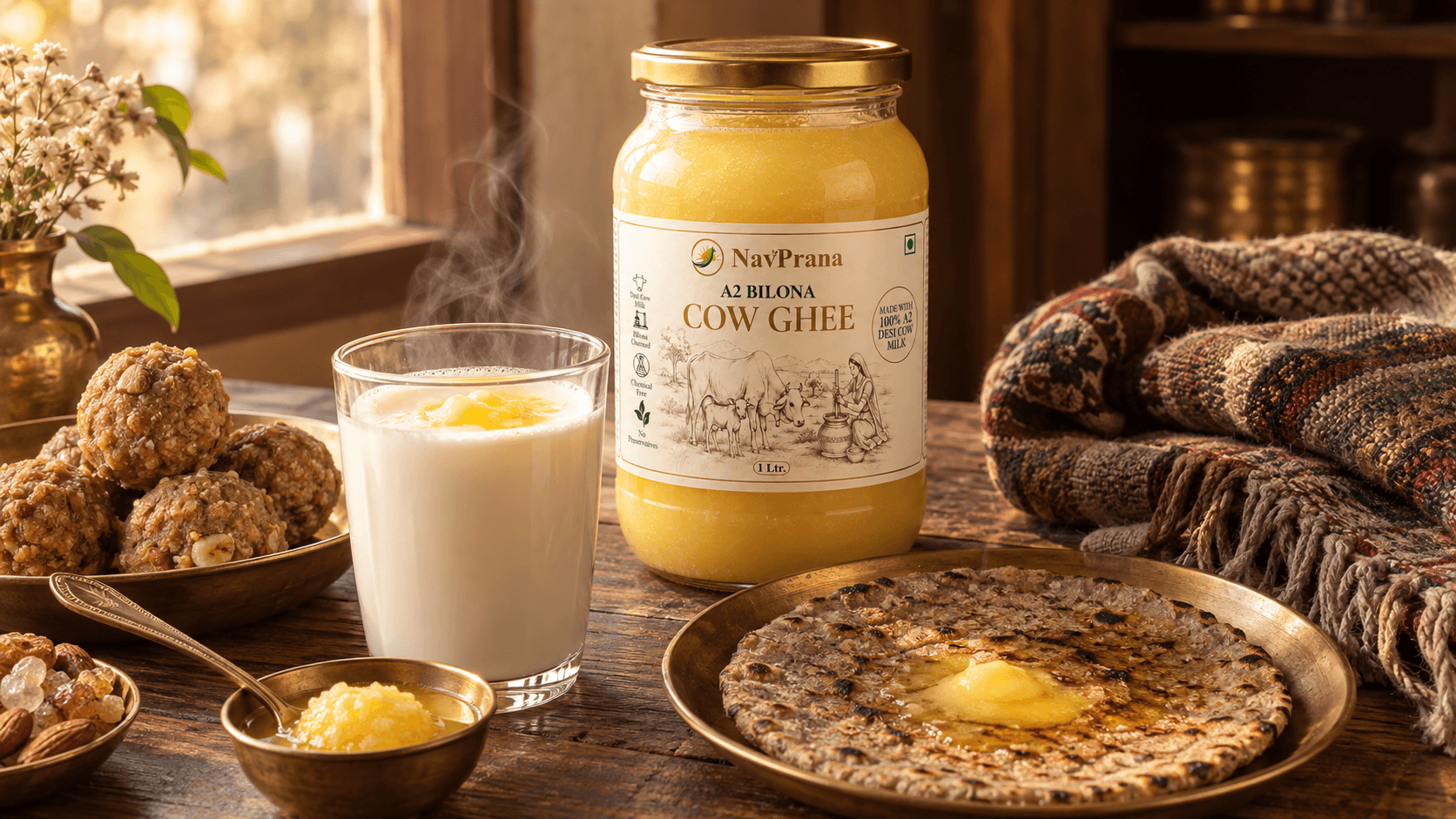
Ghee consumption in Indian homes roughly doubles once the weather turns. Gond ke laddoo appear, the tadka gets heavier, someone starts the nightly warm milk, and the jar that lasted two months in summer is gone in five weeks. Winter is the season ghee was built for. It is also the season when someone in the family will tell you it causes cough, so let us settle that part properly as well.
The Quick Answer
Winter is when ghee suits the body best, and 2 to 3 teaspoons a day is a reasonable range for an adult. Cold, dry air pulls moisture out of skin, lips and joints, and ghee works directly against that from the inside. Digestion also handles heavier food better in the cold. Pure ghee does not cause cold or cough. That belief comes from two real things getting muddled together: cold or heavy dairy on an already congested chest, and simple excess. Neither is a problem with ghee itself.
What Winter Does, and How Ghee Answers It
| Winter problem | How ghee helps | Best method |
|---|---|---|
| Dry skin, cracked lips | Internal fat plus fat-soluble vitamins; also works topically | 1 tsp in food daily, and a thin layer on lips at night |
| Cracked heels | Occlusive that seals moisture in | Massage into damp skin, socks overnight |
| Stiff, aching joints | Ayurveda's primary vata-pacifying fat | 1 tsp in warm milk at night, plus joint massage |
| Constipation | Lubricates the tract; people drink less water in winter | 1 tsp in warm milk at bedtime |
| Low energy, more hunger | Dense, slow-burning calories | Ghee as the cooking fat, plus a spoon on hot food |
| Poor sleep | Warm milk plus ghee is the traditional wind-down | 45 minutes before bed |
| Nutrient absorption | Vitamins A, D, E and K need fat to be absorbed at all | Any fat with the meal, not separate from it |
Why the Cold Season Suits Ghee
The air is drier, and so are you
This is the practical half. Cold air holds less moisture, indoor heating dries it further, and the result shows up as cracked lips, flaking skin, brittle hair and stiff joints. Fat is what the body uses to hold moisture in. People who eat very little fat feel winter more than anyone.
Digestion handles heavier food better
Ayurveda holds that agni , digestive fire, runs stronger in the cold months, which is the reasoning behind the classical seasonal regimen, ritucharya , described in the texts that underpin the formulations recognised by the Ministry of Ayush . The everyday observation behind it is easy to test: the same plate of gond ke laddoo that feels right in December feels heavy in May.
You absorb more of what you eat
Winter diets in India lean on vegetables, greens and dals. Vitamins A, D, E and K in those foods cannot be absorbed without dietary fat . A spoon of ghee on the sarson ka saag is not indulgence, it is what makes the saag worth eating.
Ghee sets and grains in the cold
A seasonal quirk worth knowing so you do not panic. Your jar will turn solid and visibly grainy in winter as the fats crystallise. That is a sign it is real, not a sign it has spoiled. Full explanation in our storage guide .
Does Ghee Cause Cold and Cough?
No, and this myth is worth taking apart carefully because it stops people eating well through the exact season ghee helps most.
Ghee is not mucus-forming. There is no mechanism by which clarified butterfat produces phlegm. In Ayurveda ghee is described as sattvik and balancing rather than kapha-aggravating, unlike heavy milk sweets or cold curd.
Three real things got tangled into the myth:
- Cold dairy on a congested chest. If you already have a blocked nose or a productive cough, cold milk, curd and ice cream genuinely feel worse. That is about temperature and about milk, not about ghee.
- Excess quantity. Four or five spoons at once causes heaviness and a coated throat, and people read that as mucus.
- Timing. Winter is both peak ghee season and peak viral season in India. Two things happening together is not one causing the other.
The practical rule: a teaspoon of ghee in warm milk or on hot food is fine even with a mild cold. If there is active heavy congestion, pause the milk, not the ghee, and take it in warm water instead.
How Much in Winter
You can sit at the upper end of the normal range: 2 to 3 teaspoons a day for an adult , counting the cooking ghee, not just the visible spoon. Children, growing teens and anyone doing physical work can go higher. ICMR-NIN's Dietary Guidelines for Indians set ceilings on total visible fat, and that covers your ghee, oil and butter together. Our age-wise dosage guide has the full breakdown.
One winter caveat that catches people out: activity usually drops in the cold while intake rises. If the jar is emptying faster and the walks have stopped, the calories are still counting.
The Traditional Winter Preparations
- Gond ke laddoo. Edible gum roasted in ghee with wheat flour, jaggery and nuts. The classic north Indian winter food, and traditionally given after childbirth as well.
- Panjiri. Same family, looser form. Dense, warming, and easy to eat a little of every day.
- A spoon on hot bajra or makki roti. Millet is a winter grain, and ghee is what makes it palatable and digestible.
- Sarson ka saag with a generous spoon stirred in at the end, which is both tradition and nutrition.
- Warm milk with ghee at night, for sleep, joints and regularity. Method in our night milk guide .
- Abhyanga, a warm ghee or oil massage before a bath. Winter is when this practice earns its reputation.
Why Buffalo Ghee Suits Winter
If you keep only one jar in the cold months, this is the one to keep. Buffalo ghee is denser and carries more calories per spoon than cow ghee, which is exactly what the season calls for. It is the traditional choice for gond ke laddoo and panjiri, for night milk, and for anyone who needs grounding and strength rather than lightness.
Cow ghee stays the better pick for daily cooking and for the morning empty-stomach routine, since it is lighter. Many households run both through winter. The comparison is in our cow ghee vs buffalo ghee guide , and if the white colour of buffalo ghee surprises you, here is why that is correct .
What Ghee Will Not Do This Winter
Worth stating, because winter wellness content oversells badly.
Ghee will not stop you catching a cold. Colds are viral. Better absorption of fat-soluble vitamins supports your immune system in a general sense, and that is a real but modest thing. It is not protection.
It is not a vitamin D source worth counting on. Vitamin D in India comes mainly from sunlight, and winter is when levels drop. If you are deficient, you need sun exposure or a supplement your doctor prescribes, not a bigger spoon of ghee.
And it will not offset a winter of no movement. If activity drops and intake rises, weight follows, whatever the quality of the fat. See the dosage guide , and ghee and diabetes if that applies to you.
One Thing to Check Before Winter Cooking Starts
Ghee consumption climbs steeply from October, and so does adulteration. Festival and winter demand is when blended jars move fastest.
Much of the ghee sold cheaply is machine-extracted from cream at high heat, and the cheaper jars are frequently cut with refined oil, vanaspati, colour and essence. India's food safety regulations require the ingredient list to declare what is in the pack, so read it before the season rather than during.
Real Bilona ghee is whole A2 milk set into curd, hand-churned into makkhan, then simmered on a low flame. One ingredient. See what bilona actually means , and the seven checks before you buy.
Frequently Asked Questions
Sardi me ghee khane ke fayde kya hai?
Sardi mein hawa sookhi hoti hai, isliye twacha, hont, baal aur jod sabse zyada rookhe hote hain. Ghee andar se wahi namee banaye rakhta hai. Iske alawa sardi mein pachan behtar kaam karta hai, isliye bhaari khana jhelta hai, aur sabziyon ke vitamin A, D, E, K bina charbi ke sharir mein jaate hi nahi. Roz do se teen chammach kaafi hai.
Ghee se sardi khansi hoti hai kya?
Nahi. Shudh ghee kaf nahi banata. Ye galatfehmi do asli baaton se bani hai: ek, agar pehle se seene mein jam hua hai to thanda doodh, dahi ya ice cream bura lagta hai, aur wo doodh ki wajah se hai ghee ki nahi. Do, zyada matra lene se bhaaripan aur gale mein chipchipahat lagti hai. Ek chammach garam doodh ya garam khaane ke saath halki sardi mein bhi theek hai. Agar zyada jam gaya hai to doodh band karein, ghee garam paani mein lein.
Sardiyon me ghee kaise khaye?
Chaar aasan tareeke: tadka mein refined oil ki jagah ghee, garam roti ya bajre ki roti par ek chammach, raat ko garam doodh mein ek chammach, aur gond ke laddoo ya panjiri. Iske saath haftе mein do teen baar garam ghee ki malish sardi mein bahut aaram deti hai.
Should I eat more ghee in winter than in summer?
Slightly more is reasonable, and most Indian households do this without thinking about it. Two to three teaspoons instead of one or two. Just remember that winter activity usually drops, so the extra calories still count.
Why does my ghee go hard and grainy in winter?
Because the fats in it crystallise as the temperature falls, and different fats set at different points. That grainy danedar look is a sign of genuine ghee rather than spoilage. Heavily processed ghee often stays smooth even in the cold.
Cow or buffalo ghee for winter?
Buffalo, if you are picking one. It is denser and more grounding, and it is the traditional choice for laddoo, panjiri and night milk. Keep cow ghee for daily cooking and the morning routine.
Stock the Winter Jar Before October
Demand climbs from Dussehra onward, and the good jars go first.
- Denser and warming, the winter choice: Buffalo A2 Bilona Ghee (1 Ltr) or the 500 ml
- Lighter, for daily cooking and morning warm water: Desi Cow A2 Bilona Ghee (1 Ltr)
Not sure how much a winter will take? Our monthly usage guide has the arithmetic. One ingredient, FSSAI certified, hand-churned from grass-fed A2 milk in the Chambal valley. Shop the collection → Free shipping on orders above ₹999.
General nutrition and traditional-practice information, not medical advice. Ghee does not prevent or treat infections. If you have a heart, liver or metabolic condition, confirm your daily fat intake with your doctor before increasing it for the season.