

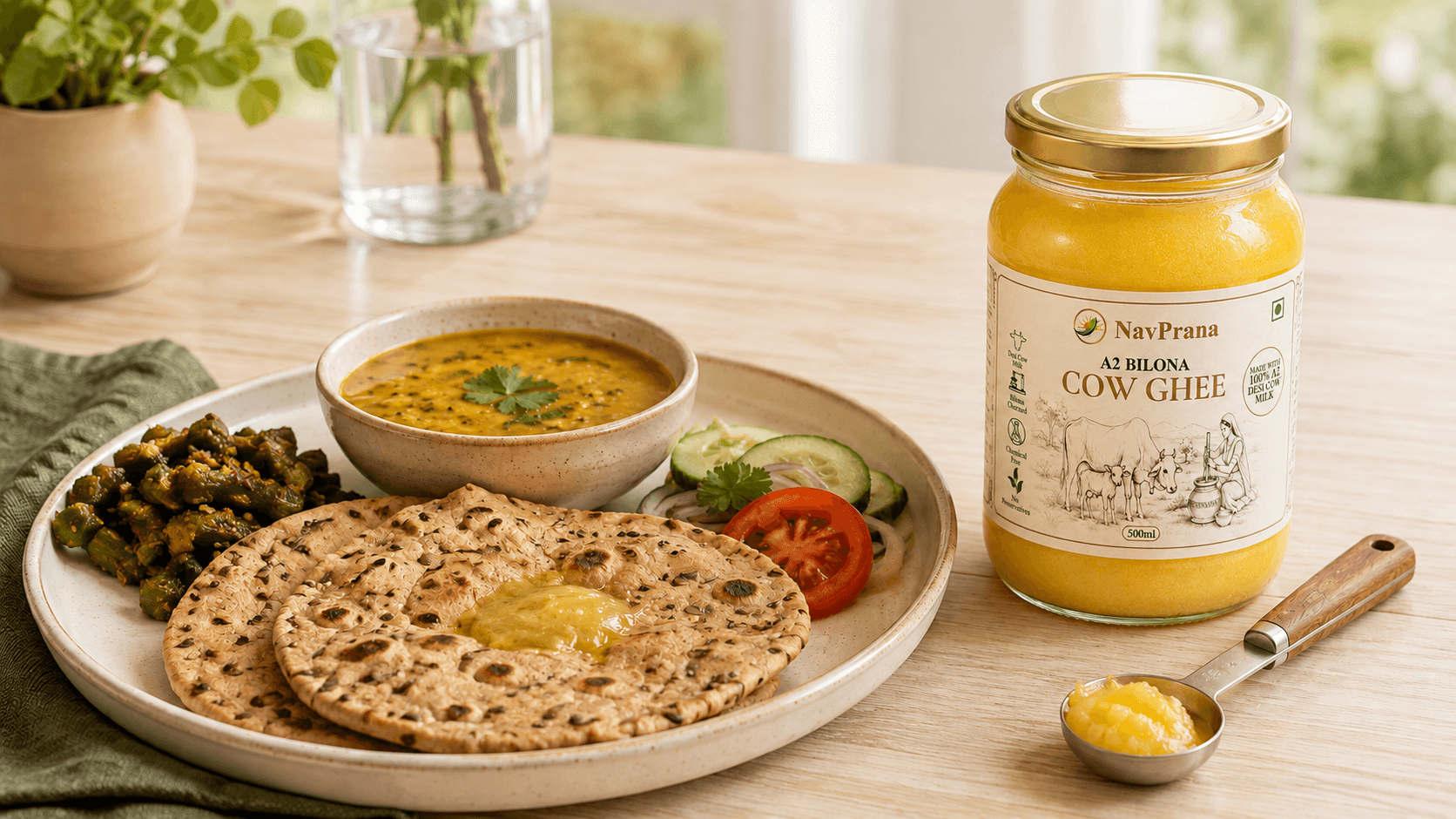
Is Ghee Good for Diabetes?
Two claims circulate and both are too confident. One says ghee is dangerous for diabetics because of saturated fat. The other says a spoon of ghee before meals controls blood sugar. Neither is supported by strong evidence. What follows is the careful version, including the parts that argue against ghee, because if you are managing a diagnosed condition you deserve better than a brand telling you what you want to hear.
The Quick Answer
Ghee contains no carbohydrate and no sugar, so it does not raise blood glucose directly. Eaten with a carb-heavy meal it slows digestion, which can soften the post-meal spike. That much is reasonable. What ghee does not do is treat or reverse diabetes, and because it is calorie-dense it can work against you if weight is part of your picture, which it usually is in type 2. One to two teaspoons a day, counted inside the total fat your doctor has set for you, is the sensible range. Replace other cooking fats with it rather than adding it on top.
What Ghee Does and Does Not Do
| Claim | Verdict | The detail |
|---|---|---|
| "Ghee spikes blood sugar" | False | Zero carbohydrate. It has no direct glycemic effect. |
| "Ghee slows the spike from rice or roti" | Likely, modestly | Fat slows gastric emptying. Real, but small, and it does not license a larger portion of rice. |
| "Ghee reverses or cures diabetes" | False | No food does this. Treat any such claim as a reason to distrust the source. |
| "Ghee improves insulin sensitivity" | Not established | Research on dietary fat and insulin resistance is mixed. Nothing here is settled. |
| "Diabetics must avoid ghee completely" | Overstated | Small amounts fit most plans. Total calories and total fat are what matter. |
| "Ghee is safer than refined oil for diabetics" | Partly | It is heat-stable and free of trans fats, which is a genuine advantage. Calorie-wise they are nearly identical. |
Why Ghee Does Not Raise Blood Sugar
Blood glucose rises from carbohydrate. Ghee is close to pure butterfat, with the milk solids and nearly all the lactose removed during clarification. There is no carbohydrate left to convert.
The second, more interesting effect is timing. Fat slows the rate at which the stomach empties, so the glucose from a meal enters the bloodstream more gradually. A teaspoon of ghee on rice does flatten the curve somewhat compared with the same rice eaten plain. The research specific to ghee is thin, though, and much of it is small or done in animals. Treat this as a reasonable mechanism rather than a proven intervention.
The Argument Against, Which Deserves Space
Most articles on this topic skip this section. It matters more than the benefits.
Weight is the main issue. In type 2 diabetes, losing weight improves glycemic control more reliably than almost any dietary tweak. The World Health Organization puts excess body weight and inactivity among the central drivers of type 2. Ghee is 45 calories a teaspoon. Added carelessly on top of an existing diet, it works directly against the thing that would help you most.
Saturated fat is a live question. Diabetes carries a higher cardiovascular risk, and standard advice for that is to keep saturated fat moderate. Ghee is high in it. The science on saturated fat has become more nuanced than the blanket warnings of twenty years ago, but nuance is not permission. If you have diabetes plus high LDL, your doctor is right to cap your ghee.
It changes nothing about the carbohydrate. A teaspoon of ghee on two parathas does not make two parathas a good idea. The portion of rice, roti and sugar is still the variable that decides your numbers.
How Much Is Sensible
| Situation | Daily ghee | Note |
|---|---|---|
| Type 2, weight in normal range, lipids fine | 1-2 tsp | Used as a replacement for other cooking fats |
| Type 2, overweight | Up to 1 tsp | Calorie total is the priority. Cut fried food first. |
| Type 2 with high LDL or heart disease | Doctor decides | Do not self-prescribe here |
| Type 1 | 1-2 tsp | No carbohydrate, so no bolus adjustment for the ghee itself |
| Gestational diabetes | Up to 1 tsp | With your obstetrician's approval. See our pregnancy guide . |
| Prediabetes | 1-2 tsp | Swap it in for refined oil rather than adding it |
One teaspoon is about 5 g and roughly 45 calories. Count your cooking ghee in this. ICMR-NIN's Dietary Guidelines for Indians set ceilings on total visible fat, covering ghee, oil and butter together. Full age-wise breakdown in how much ghee per day is safe .
Practical Ways to Use It
- As the tadka, instead of refined oil. This is the swap that costs you nothing in calories and gains you heat stability.
- A teaspoon on hot rice or roti, once a day rather than at every meal.
- With the meal, not before it. The slowing effect works when fat and carbohydrate arrive together. Taking a spoon on an empty stomach for glycemic reasons has no real basis.
- Skip the night milk if you are watching evening calories, or use it and account for the milk's own sugars.
- Do not use ghee to justify sweets. Ghee-laden halwa is a sugar problem wearing a healthy label.
What Actually Moves Your Numbers
Worth saying, since this page is about a fat and your numbers are mostly about something else. Carbohydrate quantity and quality, total calories and body weight, physical activity, sleep, and your prescribed medication are what determine glycemic control. Ghee is a rounding error next to any of them.
If you came here hoping a spoon of ghee could replace a walk after dinner or a smaller portion of rice, it cannot. Use it as a better cooking fat and put your effort where the returns are.
If You Are Eating It Daily, It Has to Be Real
This applies more to you than to most readers. Much of the ghee sold in India is machine-extracted from cream at high heat, and cheaper jars are frequently blended with refined oil, vanaspati, colour and essence. Vanaspati means industrial trans fats , which raise cardiovascular risk. Diabetes already raises cardiovascular risk. Stacking the two is the worst version of this decision.
Real Bilona ghee is whole A2 milk set into curd, hand-churned into makkhan, then simmered on a low flame. One ingredient, nothing added. Our guide to what bilona actually means explains the method, and the signs of fake ghee tells you how to check the jar you already own.
Frequently Asked Questions
Sugar ke marij ghee kha sakte hai kya?
Haan, kam matra mein. Ghee mein carbohydrate bilkul nahi hota, isliye wo seedha blood sugar nahi badhata. Roz 1 se 2 chammach theek hai, bashart ki aap use refined oil ki jagah istemal karein, uske upar nahi. Agar aapka weight zyada hai ya cholesterol high hai to apne doctor se limit tay karwayein.
Does ghee lower blood sugar?
No. It can slow the rise from a meal because fat delays gastric emptying, but that is not the same as lowering your glucose. Nothing about ghee reduces your baseline numbers, and no food substitutes for medication.
Ghee or refined oil for a diabetic?
Calorie-wise they are almost identical, so the deciding factors are heat stability and purity. Ghee holds up to Indian cooking temperatures without degrading and carries no trans fat when pure. That makes it a reasonable swap at the same calorie cost. Comparison in our ghee vs butter vs oil guide .
Can I take ghee on an empty stomach if I am diabetic?
There is no glycemic benefit to taking it alone, since the spike-slowing effect needs food alongside it. If you do the morning ritual for digestion, keep it to one teaspoon and count the calories. See the empty stomach guide .
Diabetes me kitna ghee khana chahiye?
One to two teaspoons for most people with type 2, and no more than one if you are carrying extra weight. If you also have high LDL or diagnosed heart disease, your doctor sets the number, not an article.
Is ghee better than butter for diabetes?
Marginally. Ghee has no water and almost no lactose or casein, and it is far more heat-stable, so it does not degrade during Indian cooking the way butter does. The calorie difference between them is small.
Ghee se sugar badhta hai kya?
Nahi. Ghee mein carbohydrate bilkul zero hota hai, isliye wo seedha blood sugar nahi badhata. Lekin iska matlab ye nahi ki ghee daal kar chawal ya roti ki matra badha sakte hain. Aapki sugar carbs se badhti hai, ghee se nahi, aur wo hisaab waisa ka waisa rehta hai.
Diabetes me desi ghee ke fayde kya hai?
Teen practical fayde hain. Ek, isme carbohydrate nahi hai. Do, ye tez aanch par kharab nahi hota, isliye tadka aur talne ke liye refined oil se behtar hai. Teen, khaane ke saath lene par fat pachne ki raftaar dheemi karta hai, jisse khaane ke baad ka spike thoda halka pad sakta hai. Bas ye samajh lein ki ye fayde hain, ilaj nahi.
Sugar me ghee aur roti saath kha sakte hai?
Ha, aur ye theek tarika hai. Ghee ko khaane ke saath lena hi kaam karta hai, kyunki fat aur carbohydrate saath pahunchte hain to glucose dheere nikalta hai. Roti par ek chammach, din mein ek baar. Har khaane par nahi, kyunki calories jud jaati hain.
A Better Cooking Fat, Not a Treatment
If ghee is going into your food every day, the quality of that fat is worth more attention than the quantity debate.
- Lighter, the usual choice for daily cooking: Desi Cow A2 Bilona Ghee (500 ml)
- Richer, for cooking and family meals: Buffalo A2 Bilona Ghee (500 ml)
One ingredient, FSSAI certified, hand-churned from grass-fed A2 milk. Shop the collection → Free shipping on orders above ₹999.
This article is general nutrition information and is not medical advice. It does not replace guidance from your doctor or diabetes educator. Do not change your diet, your fat intake or any medication on the basis of this page. If you have diabetes along with high cholesterol, kidney disease or heart disease, your daily fat allowance must be set by your treating doctor.