

Knees that click on the stairs. Twenty minutes of stiffness before the first walk of the day feels normal. Fingers that do not close properly in the cold. Ayurveda reads all of this as a dryness problem, and ghee is the fat it prescribes for dryness. The traditional reasoning is coherent and it has been applied for a very long time. The modern evidence for ghee specifically is thinner than most articles will admit, and there is one factor that matters more than any remedy on this page. We will get to that.
The Quick Answer
Take 1 to 2 teaspoons of pure ghee a day, most traditionally in warm milk at night, and add a warm ghee massage over the affected joints two or three times a week. Expect gradual easing of stiffness rather than pain relief, over three to four weeks. Ghee addresses dryness and comfort. It does not repair cartilage, and it does not treat rheumatoid arthritis, which is autoimmune and needs medical care. If you carry extra weight and the pain is in your knees, losing some of it will help more than anything else described here.
The Two Methods
| Method | How | What to expect | Timeline |
|---|---|---|---|
| Ghee in warm milk, night | 1 tsp in a cup of warm milk, 45 min before bed | Less morning stiffness, better sleep | 3-4 weeks |
| Ghee in food | 1-2 tsp across meals, replacing other cooking fat | General relief from internal dryness | 4-6 weeks |
| Warm ghee joint massage | Gently warmed, 10 min per joint, 2-3 times a week | Immediate short-term comfort and mobility | Same day, cumulative |
| Full body abhyanga | Before a warm bath, ideally in the evening | Overall ease, particularly in winter | 2-4 weeks |
| Ghee in warm water, morning | 1 tsp on an empty stomach | Suits people who cannot take milk | 4-6 weeks |
Timelines are typical for traditional use, not clinical outcomes. Keep total daily ghee within 1 to 2 teaspoons unless your doctor says otherwise.
The Ayurvedic Reasoning
In Ayurvedic terms, joint problems belong mostly to aggravated vata , the principle associated with dryness, lightness and movement. The picture it describes is recognisable: cracking joints, stiffness that improves with warmth and movement, symptoms that worsen in cold and dry weather and in older age.
Ghee is the primary snehana agent, meaning the substance used to reintroduce unctuousness, both taken internally and applied externally. Abhyanga , the warm oil or ghee massage, is one of the oldest documented applications, and ghrita-based preparations remain part of the classical formulations recognised by the Ministry of Ayush , with research conducted by bodies such as CCRAS .
Two things about that framework are worth noting. It is internally consistent, and it correctly predicts that warmth and lubrication ease stiff joints, which anyone with arthritis will confirm from experience. It is also not the same thing as clinical proof for plain ghee from a kitchen jar.
What the Evidence Does and Does Not Support
The fair summary, in order of how solid each point is.
- Massage and warmth ease stiffness in the short term. This is well accepted, and it is the most reliable benefit on this page. Note that the medium matters less than the massage; warm ghee is pleasant and it holds heat well, but the touch is doing much of the work.
- Very low-fat diets are not good for joints or anything else. Vitamins A, D, E and K need dietary fat to be absorbed, and vitamin D matters for bone health.
- Ghee-specific clinical evidence for arthritis is limited. Most Ayurvedic research on joint conditions studies medicated preparations, herbs cooked into ghee, rather than plain ghee. Attributing those results to your kitchen jar is not honest.
- Ghee does not rebuild cartilage. No food does. Lost cartilage does not regenerate from diet.
The Uncomfortable Part
This is the section we would leave out if we were only selling.
For knee osteoarthritis, the strongest evidence in the entire field points to two things: weight management and exercise. The World Health Organization identifies excess weight among the main modifiable risk factors, and the research on weight loss and exercise in knee osteoarthritis is far stronger than anything published on any dietary fat.
Every kilogram you carry multiplies through the knee joint with each step. So if you are overweight and your knees hurt, the most effective thing available to you is losing weight, and ghee is 45 calories a teaspoon.
That is a genuine tension and we are not going to pretend otherwise. The way to hold both is simple: use ghee as a replacement for the oil or butter you already cook with, keep it to one or two teaspoons, and do not add it on top of your existing diet. Then the calories are neutral and you get the dryness benefit without working against the thing that would help most. Our dosage guide and weight guide cover that arithmetic.
The Massage Method
- Warm the ghee gently in a small bowl placed in hot water. Comfortably warm, never hot. Test it on your inner wrist first.
- Work around the joint, not into it. Circular strokes on the muscles and tissue surrounding the knee, shoulder or ankle. Never press hard on a swollen or inflamed joint.
- Ten minutes per joint is enough. Evening works better than morning, since warmth and rest afterwards extend the effect.
- Follow with warmth. A warm bath, a hot water bag, or simply covering the joint. This matters as much as the massage.
- Two or three times a week is a sustainable rhythm. Daily is fine in winter.
Stop if the joint is hot, red, visibly swollen or acutely painful. Those signs point to active inflammation or infection, where massage can make things worse. See a doctor instead.
When to See a Doctor Rather Than Continue
- A hot, red, visibly swollen joint, particularly with fever. This needs urgent medical attention.
- Morning stiffness lasting more than an hour, or symmetrical pain in the small joints of both hands. That pattern suggests rheumatoid arthritis, which is autoimmune and needs treatment. No amount of ghee addresses it.
- Sudden severe pain after an injury, or a joint that locks or gives way.
- Pain that keeps worsening despite three or four weeks of home measures.
- Unexplained weight loss or fever alongside joint pain.
None of that is a reason for alarm on its own. It is a reason to get a diagnosis rather than manage a symptom.
What Helps Alongside
- Strength work for the muscles around the joint. For knees, quadriceps strength is one of the best-supported interventions there is, and it can be done sitting in a chair.
- Vitamin D. Deficiency is very common in India and it affects bone and muscle. Get it tested rather than guessing, and get sunlight.
- Keeping joints warm in winter, which is when most people notice the difference most.
- Movement, even when it hurts a little. Rest stiffens joints. Gentle regular walking beats both bed rest and heavy exertion.
- Enough protein, which older adults routinely under-eat and which muscle needs.
Purity Matters When You Take It Daily
If you are taking a teaspoon every night for weeks and rubbing more into your knees, the jar has to be sound.
Much of the ghee sold cheaply in India is machine-extracted from cream at high heat, and cheaper jars are frequently blended with refined oil, vanaspati, colour and essence. Vanaspati means trans fat, which raises cardiovascular risk, and joint pain in older adults very often comes with heart risk already on the chart.
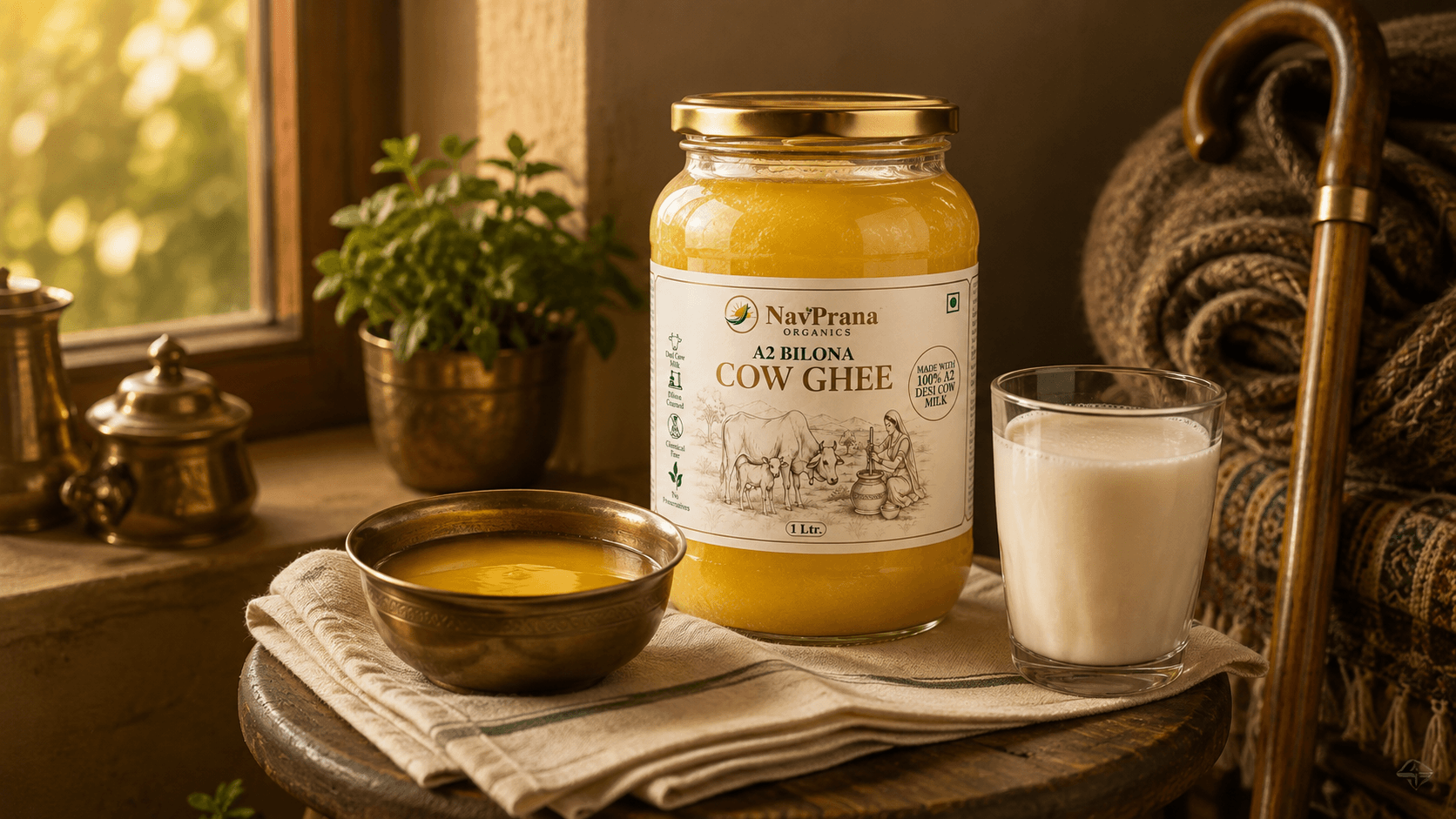
Real Bilona ghee is whole A2 milk set into curd, hand-churned into makkhan, then simmered on a low flame. One ingredient, and the grainy danedar texture and nutty aroma that follow from it. See what bilona actually means , and the signs of fake ghee to test the jar you own.
Frequently Asked Questions
Ghutno ke dard me ghee kaise use kare?
Do tareeke saath chalate hain. Andar se: roz ek chammach ghee, raat ko garam doodh mein, sone se pauna ghanta pehle. Bahar se: ghee halka garam karke ghutne ke aas paas ki maanspeshiyon par das minute halke haath se malish, hafte mein do teen baar, aur uske baad garam paani ki bottle ya garam kapda. Teen se chaar hafte mein akadan mein farak dikhta hai. Agar ghutna laal, garam ya soojа hua hai to malish na karein, doctor ko dikhayein.
Ghee se joint pain theek hota hai kya?
Theek karna aur aaram dena do alag baatein hain. Ghee rookhapan aur akadan mein aaram deta hai, aur garam malish turant thoda aaram deti hai. Par ghee ghisi hui cartilage wapas nahi banata, aur rheumatoid arthritis jaisi bimari ka ilaj nahi karta. Aur ek seedhi baat: agar wazan zyada hai aur dard ghutno mein hai, to wazan kam karna is page ki har cheez se zyada asar karega.
Jodo ke dard ke liye kitna ghee khana chahiye?
Roz ek se do chammach, aur wo bhi apne baaki cooking oil ki jagah, uske upar nahi. Zyada lene se koi extra fayda nahi hota, sirf calories badhti hain, jo ghutno par ulta asar daalti hain. Agar cholesterol ya heart ki problem hai to matra apne doctor se tay karwayein.
How long before I notice a difference?
Massage gives some comfort the same evening. Reduced morning stiffness from the internal method usually takes three to four weeks of daily use. If four weeks pass with no change at all, the cause is probably not dryness and it is worth getting properly assessed.
Is ghee good for rheumatoid arthritis?
Rheumatoid arthritis is an autoimmune disease and it requires medical treatment to prevent joint damage. Ghee does not treat it. Some people find warm massage eases stiffness on good days, but never during a flare, and never in place of your prescribed medication. Talk to your rheumatologist.
Can I use ghee for massage if I have high cholesterol?
External use is not the concern; eating it is. Keep internal ghee to about a teaspoon and let your doctor set your total daily fat. Massage as much as you find helpful.
A Teaspoon, a Massage, and the Harder Work
Use it as your cooking fat rather than an addition, warm it for the massage, and put the real effort into movement and weight. That combination is honest and it works.
- Lighter, for daily cooking and morning use: Desi Cow A2 Bilona Ghee (500 ml)
- Denser and grounding, traditional for night milk and winter massage: Buffalo A2 Bilona Ghee (500 ml)
Stiffness worse in the cold months? Our guide on ghee in winter covers the seasonal routine. One ingredient, FSSAI certified, hand-churned from grass-fed A2 milk. Shop the collection → Free shipping on orders above ₹999.
NavPrana ghee is a food product and we make no therapeutic claims for it. This article describes traditional practices and summarises general evidence; it is not medical advice and does not replace a diagnosis. See a doctor for any hot, swollen or acutely painful joint, for prolonged morning stiffness, or before starting a new regimen alongside prescribed medication.