

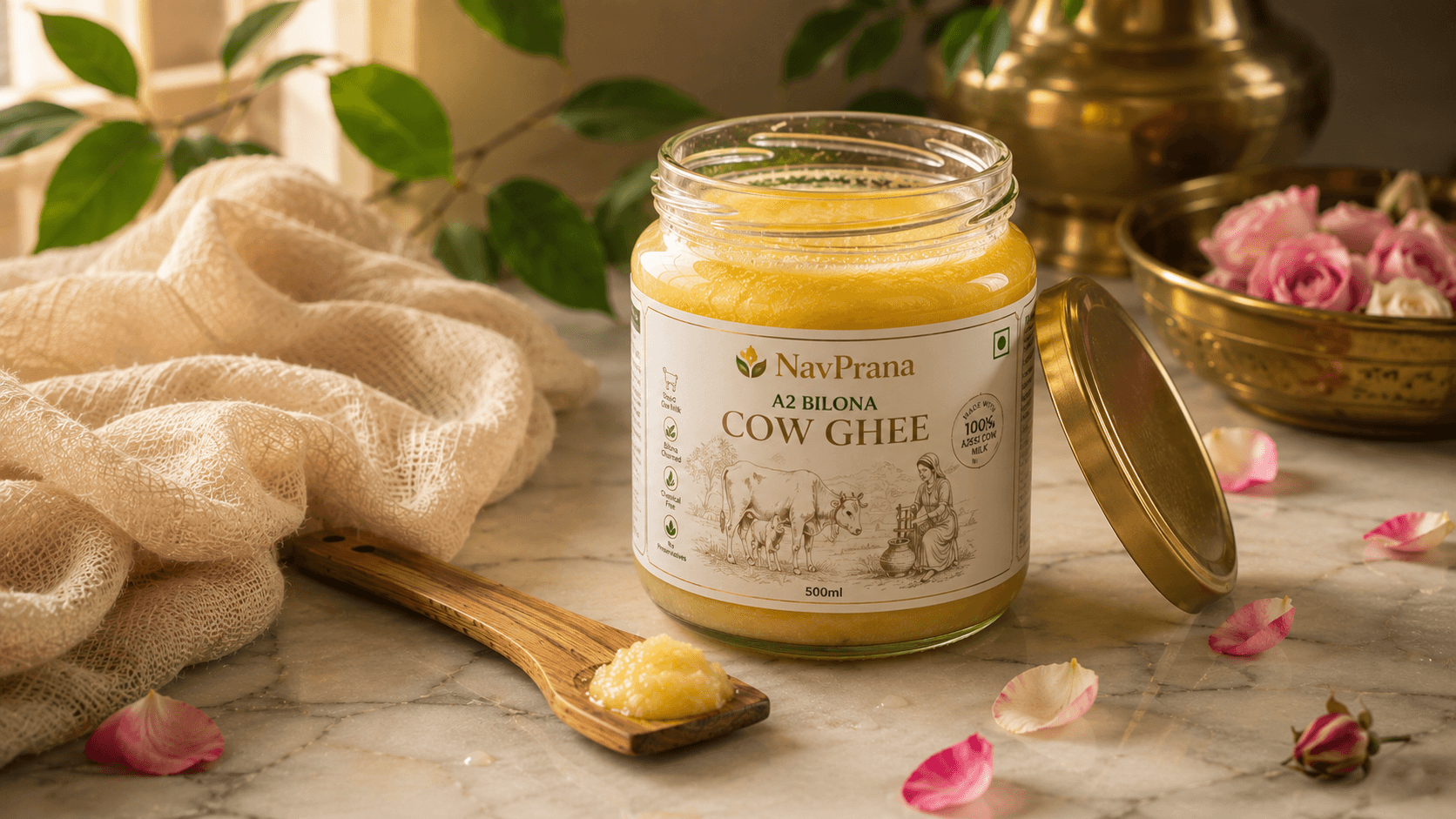
Ghee for Skin and Hair: 8 Uses That Work (and 3 That Don't)
There is a jar in your kitchen that costs a fraction of the serum on your dressing table, and your grandmother used it on your lips every winter without reading a single ingredient list. Ghee has been an Indian skin and hair remedy for centuries. Some of what it gets credited with holds up well. Some of it does not, and you should know which is which before you put fat on your face.
The Quick Answer
Ghee is an excellent occlusive moisturiser and a poor treatment. It seals water into skin, which makes it very good for dry lips, cracked heels, flaky patches and dry scalp. It will not clear acne, regrow hair in pattern baldness, or lighten pigmentation. Use a thin layer at night, always on clean skin, and always food-grade pure ghee. If your skin is oily or acne-prone, keep it off your face entirely and use it on lips, heels and hair ends instead.
What Works, and What to Expect
| Use | How to apply | What to expect | How solid the basis |
|---|---|---|---|
| Chapped lips | Thin layer at bedtime, every night | Noticeably softer in 1 to 2 nights | Strong. Pure occlusive science. |
| Cracked heels, elbows, knees | Massage into slightly damp skin, cover with socks overnight | Days to soften, weeks for deep cracks | Strong |
| Under-eye dryness | Two drops, ring finger, gentle taps at night | Less crepey dryness. No effect on pigmentation. | Partial |
| Dry-skin face massage | 3 to 4 drops, 5 minutes upward, wipe off | Temporary glow from circulation plus barrier support | Traditional |
| Dry, flaky scalp | Warm slightly, massage in, leave 30 to 60 minutes, then shampoo | Less itching and flaking | Traditional |
| Split, frizzy hair ends | A very small amount on the last two inches only | Ends look sealed and less frizzy | Strong |
| Baby massage | Warm, gentle strokes before bath | Soft skin, settled baby | Traditional |
| Nasya (nostrils) | 1 to 2 drops, only with practitioner guidance | Relief from nasal dryness | Traditional, needs caution |
Why Ghee Works on Skin at All
Skin loses water constantly. Most dryness is not a shortage of oil, it is water escaping through a weakened barrier. An occlusive sits on top and slows that loss.
Ghee is close to pure fat with no water in it, which makes it a strong occlusive. It also carries the fat-soluble vitamins A, D, E and K, and short-chain fatty acids including butyric acid. Classical Ayurveda treats ghrita as the base for a large number of topical and nasal preparations, and the Ministry of Ayush still lists ghrita-based formulations among recognised classical medicines.
One caveat worth carrying through the rest of this article: most published research looks at medicated ghrita, meaning ghee cooked with specific herbs, rather than plain ghee from a kitchen jar. The studies that exist are mostly small. Traditional use is a reasonable basis for a moisturiser. It is not the same as clinical proof.
The Uses Worth Your Time
1. Chapped lips, which is the single best use
Lip skin has no oil glands and almost no barrier, so it dries faster than anywhere else on the body. A thin layer of ghee at bedtime outperforms most commercial lip balms, and it has no fragrance, no menthol and no petroleum. Apply it as the last thing before you sleep. That is the entire method.
2. Cracked heels, elbows and knees
Massage it into slightly damp skin so you trap water underneath rather than sealing dry skin. Socks over the feet make a large difference. Deep, painful cracks need a doctor, not a kitchen remedy.
3. Under-eye dryness
The skin here is the thinnest on the face, and it creases when dehydrated. Two drops tapped in with the ring finger at night helps that crepey look. Be clear about what it does though. Dark circles caused by pigmentation, thin skin showing blood vessels, or genetics will not shift, and no oil changes them.
4. Face massage for dry skin only
Three or four drops, five minutes of upward strokes, then wipe off with a warm damp cloth. The glow afterwards is circulation plus a temporarily better barrier. Do not sleep in a thick layer on the face.
5. Scalp and hair ends
Warm a small amount, work it into the scalp with fingertips, leave it 30 to 60 minutes, then shampoo. This addresses dryness and flaking. For hair itself, keep ghee on the last two inches only. Roots get greasy, ends get the benefit.
Nasya, and Why It Needs Care
Nasya, the practice of placing a drop or two of ghee in each nostril, is a genuine classical procedure documented in Ayurvedic texts and researched by bodies such as CCRAS. People use it for nasal dryness, particularly in winter or in air-conditioned offices.
Two cautions, and they matter. Do it under practitioner guidance rather than from a video, and never attempt it if you have a sinus infection, a blocked nose, or any history of aspiration risk. Oil entering the airway is a real hazard. This one is not a casual experiment.
What Ghee Will Not Do
Three claims circulate widely and none of them survives scrutiny.
- It will not clear acne. Ghee is moderately comedogenic, meaning it can block pores in people prone to that. If your skin is oily or you break out easily, keep ghee off your face. Hormonal acne needs medical treatment, and adding an occlusive fat usually makes it worse.
- It will not regrow hair. Oiling reduces breakage and mechanical damage, which can make hair look thicker. Pattern hair loss is follicular and hormonal, and no oil reverses it. Anyone promising otherwise is selling something.
- It will not lighten pigmentation, fade melasma or undo sun damage. Ghee has no SPF and no active brightening compound. Sunscreen does that work.
None of this makes ghee useless. It makes it a moisturiser, which is a genuinely useful thing to be.
Eating It Matters More Than Applying It
Here is the part the beauty angle tends to miss. Most persistent dryness starts on the inside, and no amount of topical fat fixes a diet with too little of it. Very low-fat eating shows up as dull skin, brittle hair and cracked lips, partly because vitamins A, D, E and K need dietary fat to be absorbed at all.
One to two teaspoons of ghee a day in your food does more for skin over a month than a nightly layer does. Our guides on how much ghee per day is safe and the morning empty-stomach ritual cover the practical side, and the night milk routine is the traditional answer for internal dryness.
On Your Skin, Purity Counts Twice
Eating adulterated ghee is bad. Rubbing it into your face, your baby's skin, or your nostrils is worse, because you are applying it undiluted and leaving it there for hours.
A large share of ghee sold in India is machine-extracted from cream at high heat, and cheaper jars are frequently blended with refined oil, vanaspati, artificial colour and essence. India's food safety regulations define what may legally be called ghee, so the label has to declare what is in it. Read it. One ingredient, or put the jar back.
Real Bilona ghee is made the slow way: whole A2 milk set into curd, hand-churned into makkhan, then simmered on a low flame. That is what leaves the grainy danedar texture, the nutty aroma, and the fat-soluble vitamins intact. If you want to check what is already in your kitchen, run it past the signs of fake ghee. NavPrana's Desi Cow A2 Bilona Ghee is single-ingredient and hand-churned in small batches.
Frequently Asked Questions
Ghee chehre par lagane se kya hota hai?
On dry skin, a few drops massaged in at night soften the surface and reduce flaking, and the massage itself brings a short-lived glow. On oily or acne-prone skin it can block pores and cause breakouts. So it depends entirely on your skin type. Dry skin, yes. Oily skin, keep it to lips and heels.
Balo me ghee lagane se baal badhte hain?
Hair does not grow faster from ghee. What happens is less breakage, because oiled hair suffers less mechanical damage from combing and washing, and hair that breaks less looks longer and thicker over time. Real hair loss needs a doctor, not an oil.
Can I leave ghee on my face overnight?
Only if your skin is dry and you use a very thin layer. A thick coat overnight traps sweat and bacteria against the skin and often causes congestion by morning. On lips, overnight is ideal.
Is ghee good for dark circles?
It helps the dryness and fine creasing around the eyes. It does nothing for pigmentation or for thin skin showing the vessels underneath, which is what most dark circles actually are. Sleep and sun protection matter far more here.
Ghee or coconut oil for skin?
Both are occlusives and both work. Ghee is richer and better for very dry or mature skin and for lips. Coconut oil is lighter and spreads more easily, but it is also more likely to clog pores on the face. For hair, either works; for lips, ghee wins.
Can I use ghee on my baby's skin?
A gentle pre-bath massage with pure ghee is a long-standing Indian practice and is generally well tolerated. Patch-test on a small area first, keep it away from the face, and check with your pediatrician if your baby has eczema or any diagnosed dairy allergy. See also our guide to ghee for babies.
One Jar, Two Jobs
Use it on your lips tonight. Use it in your dal tomorrow. Just make sure the jar deserves both.
- Lighter and golden, the usual pick for skin and daily food: Desi Cow A2 Bilona Ghee (500 ml)
- Richer and denser, better for cooking and winter nourishment: Buffalo A2 Bilona Ghee (500 ml)
One ingredient, FSSAI certified, hand-churned from grass-fed A2 milk. Shop the collection → Free shipping on orders above ₹999.
NavPrana ghee is a food product, not a certified cosmetic, and we make no cosmetic or medical claims for it. This article describes traditional practices and general skincare principles, not medical advice. For acne, hair loss, eczema or persistent pigmentation, see a dermatologist. Do not attempt nasya without qualified guidance.