

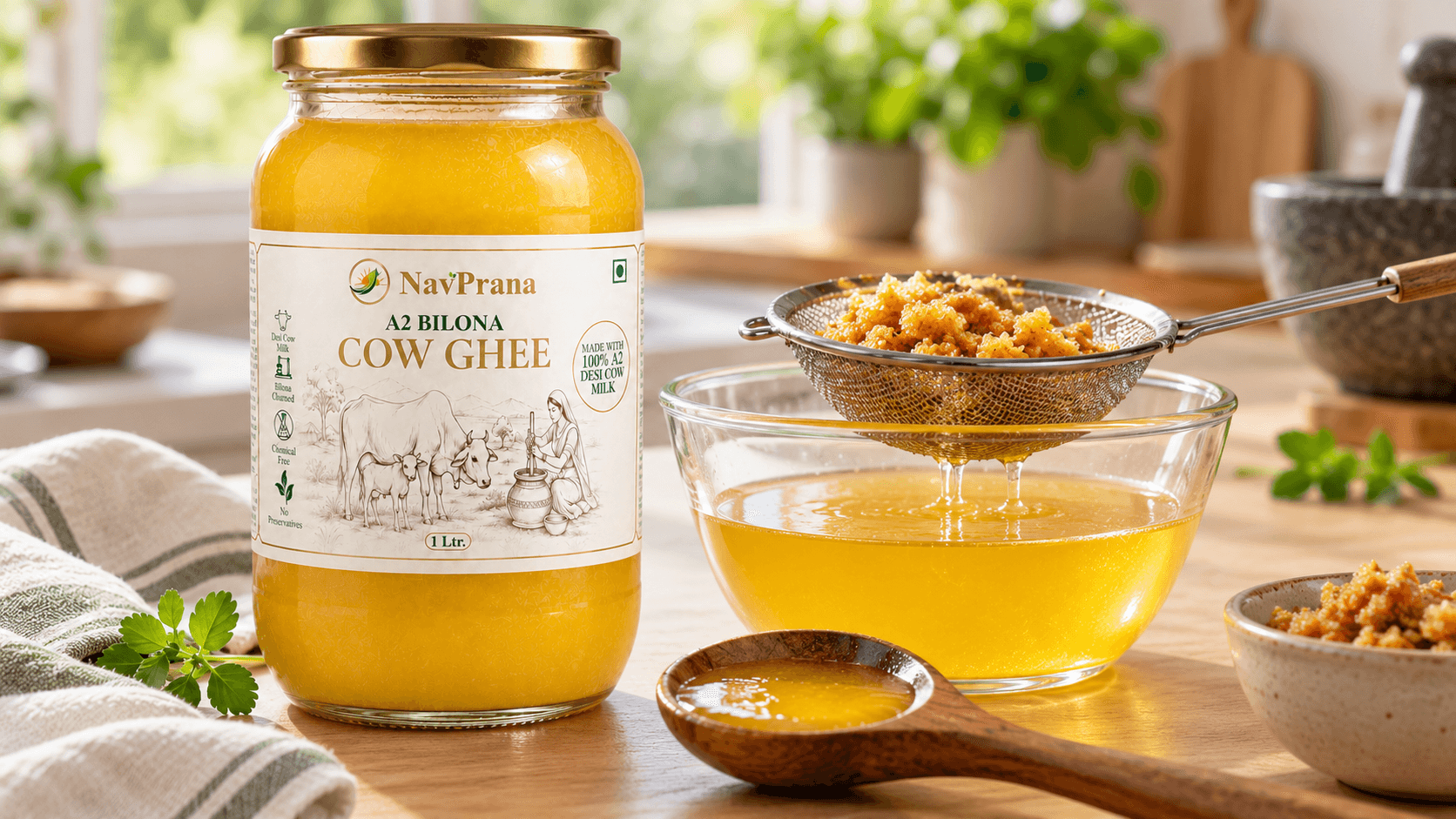
You stopped dairy because milk was giving you trouble. Then an aunt told you ghee is fine, it is not really dairy. Then a food label told you ghee is a milk product. Both statements are technically correct, which is why this question never gets a useful answer. The real answer depends on one distinction that most articles skip entirely, and getting it wrong is dangerous for a small number of people.
The Quick Answer
Ghee is made from dairy, but the clarification process removes the milk solids, and that is where lactose and casein live. What remains is trace amounts rather than zero. Most people with lactose intolerance handle pure ghee without any problem, which is why it appears in so many dairy-free kitchens. It is not certified lactose free, and it is not automatically safe for a diagnosed milk protein allergy. Lactose intolerance and milk allergy are two different conditions with two different answers, and the rest of this article is mostly about telling them apart.
The Distinction That Decides Everything
| Lactose intolerance | Milk protein allergy (CMPA) | |
|---|---|---|
| What it is | A digestive issue. Not enough lactase enzyme to break down milk sugar. | An immune reaction to milk proteins, casein or whey. |
| What triggers it | Lactose, the sugar in milk | Protein, in even very small amounts |
| Typical reaction | Bloating, gas, cramps, loose stools | Rash, vomiting, swelling, breathing difficulty. Can be severe. |
| How serious | Uncomfortable, not dangerous | Can be life-threatening |
| Milk | Usually a problem | Not safe |
| Butter | Often tolerated in small amounts | Not safe |
| Ghee | Usually well tolerated | Only with your doctor's clearance |
| Who decides | You can test carefully yourself | Your doctor. Never experiment. |
If you have never been tested and you are unsure which of the two you have, treat yourself as the second column until a doctor says otherwise.
Where Lactose Actually Sits in Milk
This is the bit that makes the whole thing make sense.
Milk is roughly three things: water, fat, and everything dissolved or suspended in the water. Lactose is a sugar, and sugars dissolve in water. Casein and whey are proteins, and they sit in the same watery portion. Fat holds almost none of it.
So the more completely you separate the fat from everything else, the less lactose and protein you carry forward. Milk has all of it. Butter has less, because it is mostly fat with some water and solids still mixed in. Ghee has the least, because clarification is precisely the act of driving off the water and lifting out the solids.
What Clarification Removes
Making ghee does two things to what started as butter.
- The water boils off. Whatever lactose was dissolved in that water has nowhere to stay.
- The milk solids separate and are removed. They sink, brown, and get strained out. Those solids carry the casein and most of the remaining lactose.
What is left is close to pure butterfat. India's compositional standard for ghee caps moisture at a very low level, which is the same reason ghee keeps for a year without refrigeration. Low water means low lactose and long shelf life for the same underlying reason.
Published work on ghee composition puts residual lactose at trace levels, though figures vary with how thoroughly the product was clarified. Which brings us to the honest part.
Why We Will Not Print "Lactose Free"
Trace is not zero, and lactose free is a regulated claim.
Using that phrase on a label means meeting a defined threshold and holding test data to prove it. We do not currently publish a lactose figure for our own batches, so we are not going to make the claim, and you should be sceptical of any ghee brand that does without showing a test report.
What we will say is what is defensible: the process removes the milk solids, what remains is trace, and most lactose intolerant people find pure ghee sits comfortably. That is a weaker sentence than the marketing version, and it has the advantage of being true.
Does the Making Method Change This?
A reasonable question, and the honest answer is a qualified yes.
The traditional Bilona method ferments the milk into curd before churning, and fermentation itself consumes some lactose. It then simmers the makkhan slowly and long, which separates the solids more completely than a fast industrial clarification does. Both steps point in the same direction.
What we will not do is turn that into a number. Nobody certifies the difference, method claims on Indian ghee labels are unregulated, and the variation between producers is larger than the variation between methods. If residual lactose genuinely matters for you medically, a test report beats any process story, ours included. Our explainer on what bilona actually means covers why the word carries no legal weight in India.
Testing It for Yourself, Carefully
This section is for lactose intolerance only. If you have a diagnosed milk allergy, skip it and talk to your doctor.
- Start absurdly small. A quarter teaspoon, with food, on a day when nothing else unusual is going on.
- Wait a full 24 hours before deciding anything. Digestive reactions are not always immediate.
- If nothing happens, go to half a teaspoon for a few days, then one.
- Change one thing at a time. Testing ghee in a week when you also started a new supplement tells you nothing.
- Stop if you react, and mention it to your doctor rather than pushing through.
Tolerance thresholds vary enormously between people, which the research on lactose intolerance reflects. There is no universal safe amount, only yours.
If You Have a Milk Allergy, Read This Twice
Cow milk protein allergy is an immune reaction , not a digestive one, and the immune system can respond to very small quantities of protein. Ghee contains trace casein. Trace is not none.
Some people with mild CMPA are cleared by their doctor to use ghee. Others are not. That decision belongs to the person who knows your allergy history and can supervise a challenge safely. Do not decide it from an article, ours or anyone else's, and do not let a well-meaning relative decide it for you.
This matters most for infants, where CMPA is more common and reactions can be severe. Our guide to ghee for babies and the one on choosing ghee for babies both say the same thing: pediatrician first.
Why Purity Matters Even More Here
If you are avoiding dairy for medical reasons, you need the label to be accurate, and that is exactly where cheap ghee fails.
Much of the ghee sold cheaply in India is machine-extracted from cream at high heat, and cheaper jars are frequently blended with refined oil, vanaspati, colour and essence. A blended product tells you nothing reliable about what is in it, including how well the milk solids were separated. Worse, some adulterants are themselves common allergens.
One ingredient on the label, or put it back. Our guide to the seven checks before you buy covers what to look for, and the signs of fake ghee covers testing a jar you already own. For general consumer guidance, Eat Right India is the official reference.
Frequently Asked Questions
Ghee me lactose hota hai kya?
Bahut hi kam, lekin bilkul zero nahi. Lactose doodh ke paani wale hisse aur thos kan mein hota hai, charbi mein nahi. Ghee banate waqt paani udd jaata hai aur thos kan chhaan kar nikal diye jaate hain, isliye jo bachta hai wo lagbhag shudh charbi hai. Isi wajah se zyadatar lactose intolerant log ghee aaram se paate hain. Par ise lactose free kehna galat hoga.
Lactose intolerance me ghee kha sakte hai?
Aam taur par haan, aur bahut se log khate hain. Shuruaat chauthai chammach se karein, khaane ke saath, aur poore 24 ghante intezaar karein. Koi dikkat na ho to dheere dheere badhayein. Har vyakti ki sahan shakti alag hoti hai, isliye koi ek fixed matra nahi hoti. Agar aapko doodh ki protein allergy hai, to ye tareeka bilkul na apnayein aur doctor se poochein.
Ghee dairy free hota hai kya?
Nahi. Ghee doodh se hi banta hai, isliye wo dairy product hai. Sawaal ye nahi ki wo dairy hai ya nahi, sawaal ye hai ki usme lactose aur milk protein kitna bacha hai. Aur uska jawab hai: bahut kam, par kuch to hai.
Is ghee safe if I am vegan?
No. Ghee is an animal product made from milk, so it is outside a vegan diet regardless of how little lactose it contains. Lactose content and vegan suitability are separate questions.
Is ghee better than butter for lactose intolerance?
Yes, and the reason is structural. Butter retains water and milk solids, which is where lactose sits. Ghee has both removed. Many people who react to butter find ghee sits fine. Our ghee vs butter vs oil guide covers the other differences.
Does cow or buffalo ghee have less lactose?
The clarification process matters far more than the animal. Both are clarified the same way and both end up at trace levels. Choose between them on density, colour and use, which our comparison guide covers.
Can I use ghee if my baby has a milk allergy?
Ask your pediatrician, and do not test it at home. Infant CMPA reactions can be severe, and this is not a decision to make from a website.
One Ingredient, and We Will Tell You What Is In It
If you are buying ghee because you are managing what dairy you can handle, buy from someone whose label you can trust.
- Lighter and golden, the usual daily choice: Desi Cow A2 Bilona Ghee (500 ml)
- Creamy white and denser: Buffalo A2 Bilona Ghee (500 ml)
Whole A2 milk set into curd, hand-churned, simmered slow. One ingredient, FSSAI certified, nothing added. Start with the 500 ml if you are testing your own tolerance. Shop the collection → Free shipping on orders above ₹999.
NavPrana does not label its ghee as lactose free and makes no allergen claims for it. This article is general information, not medical advice. Lactose intolerance and cow milk protein allergy are different conditions with different risks. If you have a diagnosed milk allergy, or you are unsure which condition you have, speak to your doctor before eating ghee. Never test a suspected allergy at home.