

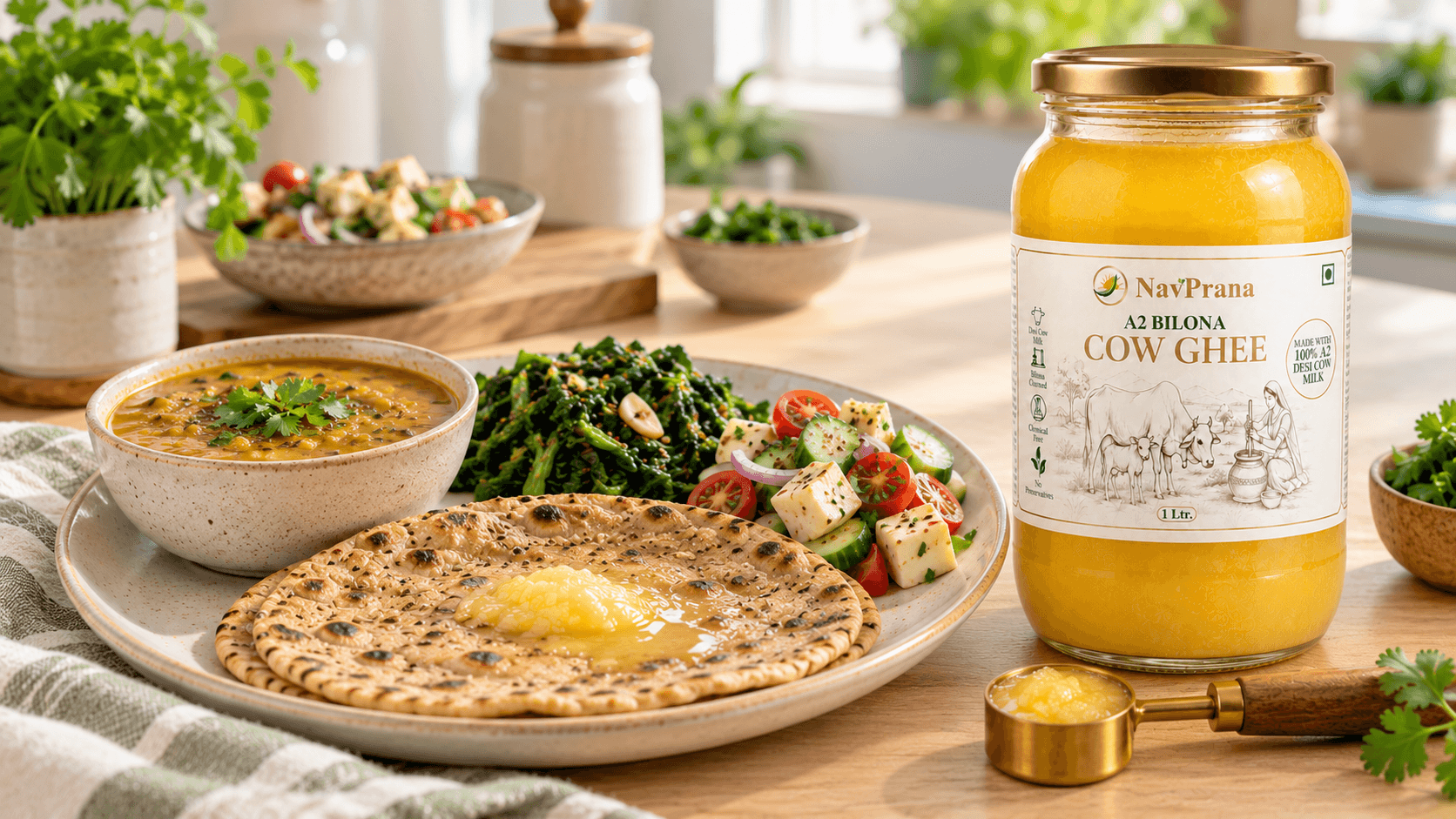
Search ghee for PCOS, or PCOS and diet, and you will be told to cut all dairy within the first three results. Search a little further and someone will tell you a spoon of ghee every morning balances your hormones. Both of those are confident and neither is supported. PCOS affects a large share of women of reproductive age, and it deserves better information than this. Here is what ghee genuinely does, what it cannot touch, and the one thing that carries more evidence than any food on the list.
The Quick Answer
Ghee has no carbohydrate and does not raise insulin directly, so it is not a food you need to avoid with PCOS. Eaten with a meal it slows digestion, which softens the blood-sugar spike that drives insulin, and that is a small genuine benefit given how central insulin resistance is to PCOS. It does not treat PCOS, restore ovulation, regulate cycles or balance hormones. One to two teaspoons a day is sensible, used to replace other cooking fat rather than added to it, because weight and insulin sensitivity are what move the condition and ghee is 45 calories a spoon.
Claim by Claim
| What you have read | Verdict | The detail |
|---|---|---|
| "Cut all dairy for PCOS" | Overstated | Blanket dairy elimination is not standard advice. Ghee in particular has almost no lactose or protein left. |
| "Ghee balances hormones" | False | No food balances hormones. This is marketing language with nothing behind it. |
| "Ghee spikes insulin" | False | Zero carbohydrate. It has no direct insulin effect. |
| "Fat with carbs softens the glucose spike" | Likely, modestly | Fat slows gastric emptying. Real, small, and not a licence for more rice. |
| "Ghee helps you lose PCOS weight" | Indirect at best | It aids satiety. It also adds calories. Net effect depends entirely on your total. |
| "Ghee improves fertility" | No evidence | Treat any source making this claim as unreliable throughout. |
Why Insulin Is the Centre of This
For a large proportion of women with PCOS, insulin resistance sits underneath the symptoms. Higher circulating insulin drives the ovaries to produce more androgens, and that shows up as irregular cycles, acne, unwanted hair growth and difficulty losing weight. The World Health Organization describes PCOS as a common cause of ovulatory infertility and notes its association with metabolic problems.
Which is why dietary advice for PCOS is really advice about blood sugar. And it is why ghee, which contains no carbohydrate at all, is not the villain some articles make of it. The research on diet and weight in PCOS points consistently at carbohydrate quality, total calories and body weight, not at whether you cook in ghee or refined oil.
The Small, Real Benefits
It flattens the curve on a carb-heavy plate
Indian meals lean on rice and roti. Adding fat to a carbohydrate meal slows how quickly glucose enters the bloodstream, which means a gentler insulin response. A teaspoon of ghee on the rice is a low-effort version of a principle PCOS dietitians teach anyway: never eat carbohydrate naked.
It keeps you full
Hunger management is not a small thing in PCOS, where cravings and insulin swings feed each other. Fat slows gastric emptying and reduces the mid-afternoon collapse that ends in biscuits. That is genuinely useful.
It helps you absorb what you are eating
Vitamins A, D, E and K need dietary fat. Vitamin D deficiency is very common in Indian women and is frequently discussed alongside PCOS, so absorbing what you eat and what you supplement matters.
It is a better cooking fat than what it usually replaces
Ghee is heat-stable and free of trans fat when pure. Repeatedly reheated refined oil is neither. That swap is a small improvement for anyone, PCOS or not.
Do You Need to Cut Dairy?
This is the most common question and the advice online is much more confident than the evidence.
Some women with PCOS report that reducing dairy helps their skin or bloating, and that is worth taking seriously as personal experience. But blanket dairy elimination is not established management, and it carries a real cost in calcium and protein for young women.
Ghee sits outside most of this debate anyway. The clarification process removes the milk solids, which is where the lactose and the casein live. So if your concern with dairy is protein or lactose, ghee is the dairy product least likely to be involved. We explain the protein side in our A2 vs A1 guide .
If you want to test whether dairy affects you, do it properly: remove it for three or four weeks, then reintroduce one item at a time and observe. Guessing from an article, ours included, tells you nothing about your own body.
What Ghee Cannot Do
This section matters more than the benefits, because PCOS content online is full of promises.
Ghee does not regulate your cycle. It does not restore ovulation, lower testosterone, shrink cysts or improve AMH. No food does any of that, and anyone telling you otherwise is either mistaken or selling something.
It does not improve fertility. There is no evidence for this claim. It appears frequently in Indian wellness content because it is emotionally powerful, which is exactly why it should be treated with suspicion.
It cannot replace metformin, inositol, or whatever your doctor has prescribed. People do stop medication in favour of home remedies, and with PCOS that can mean losing years.
And it will not help if it pushes your calories up. Which brings us to the uncomfortable part.
The Uncomfortable Part
For women with PCOS who are carrying extra weight, modest weight loss has stronger evidence behind it than any dietary tweak on this page , including improvements in insulin sensitivity and in cycle regularity. And ghee is calorie-dense.
So there is a genuine tension in recommending it, and the resolution is the same one we give everywhere: replace, do not add. A teaspoon of ghee is about 45 calories, a teaspoon of refined oil about 40. Swap one for the other and your total does not change. Stack ghee on top of your existing cooking oil and it works against the thing that would help you most.
Measure it. One to two teaspoons, counted inside your day, not poured freely from the jar. Our dosage guide and weight guide cover the arithmetic, and ICMR-NIN's Dietary Guidelines for Indians set the visible-fat ceilings that ghee counts inside.
What Really Helps
- Strength training. Muscle improves insulin sensitivity directly, and this is under-prescribed to Indian women. Two or three sessions a week.
- Carbohydrate quality over quantity panic. Millets, whole dals and vegetables instead of white rice, maida and sugar. You do not have to eliminate carbs.
- Protein at every meal. Most Indian PCOS diets are badly short on it, and it does more for satiety than fat does.
- Sleep, which affects insulin resistance more than most people expect.
- Vitamin D testing, rather than guessing.
- Your doctor's plan. PCOS is a medical condition with real treatments, and diet supports them rather than replacing them.
If Ghee Is in Your Daily Cooking, Make It Real
Whatever quantity you settle on, it should be what the label says it is. Much of the ghee sold cheaply in India is machine-extracted from cream at high heat, and the cheaper jars are frequently blended with refined oil, vanaspati, colour and essence. Vanaspati means trans fat, and PCOS already carries a higher long-term metabolic and cardiovascular risk. Adding that on purpose makes no sense.
India's food safety regulations require the ingredient list to declare what is in the pack, so read it. One ingredient. Real Bilona ghee is whole A2 milk set into curd, hand-churned into makkhan, then simmered on a low flame. See what bilona actually means and the seven checks before you buy.
Frequently Asked Questions
PCOS me ghee kha sakte hai kya?
Haan, thodi matra mein. Ghee mein carbohydrate bilkul nahi hota, isliye wo seedha insulin nahi badhata. Roz ek se do chammach theek hai, par use apne purane cooking oil ki jagah lein, uske upar nahi. PCOS mein wazan aur insulin sensitivity sabse zyada mayne rakhte hain, aur ghee calorie dense hai, isliye matra napkar lein.
PCOS me desi ghee se hormones theek hote hai kya?
Nahi. Koi bhi khana hormones ko theek nahi karta. Ghee se na periods regular hote hain, na ovulation wapas aata hai, na testosterone kam hota hai. Jo bhi ye daawa kare, uski baaki baaton par bhi bharosa mat kijiye. Ghee ka chhota sa fayda ye hai ki wo khaane ke saath blood sugar ka spike thoda halka karta hai, bas.
PCOD me dairy chhodna zaroori hai kya?
Zaroori nahi. Poori dairy band karna koi standard salaah nahi hai, aur young women ke liye calcium aur protein ka nuksan hota hai. Kuch mahilaon ko dairy kam karne se skin ya bloating mein farak dikhta hai, jo apni jagah sach hai. Ghee waise bhi is bahes se bahar hai, kyunki usme lactose aur protein lagbhag bacha hi nahi hota.
Does ghee cause weight gain in PCOS?
Only if it adds to your total. One to two teaspoons replacing the oil you already use is close to calorie-neutral. Four spoons poured on top of an existing diet is 180 extra calories a day, which over months is exactly the direction you do not want with PCOS.
Is ghee better than coconut oil or olive oil for PCOS?
No fat is a PCOS treatment, so this is a smaller question than it looks. Ghee is heat-stable and suits Indian cooking; olive oil is better for cold uses. Pick one per meal and count it. Comparison in our ghee vs butter vs oil guide .
Can I take ghee on an empty stomach for PCOS?
There is no PCOS-specific benefit to that. The spike-softening effect needs food alongside it, so ghee taken with meals makes more sense here. If you do the morning ritual for digestion, keep it to one teaspoon and count it. See the empty stomach guide .
A Cooking Fat, Measured
Use it in place of what you already cook with, keep it to a teaspoon or two, and put your energy into protein, strength training and sleep. That is the honest version.
- Lighter, for everyday cooking: Desi Cow A2 Bilona Ghee (500 ml)
- Richer, for family cooking: Buffalo A2 Bilona Ghee (500 ml)
One ingredient, FSSAI certified, hand-churned from grass-fed A2 milk. Shop the collection → Free shipping on orders above ₹999.
NavPrana makes no hormonal, fertility or PCOS-related claims for its products. This article summarises general nutrition information and is not medical advice. PCOS is a medical condition requiring diagnosis and management by a doctor. Do not stop or change prescribed treatment on the basis of dietary information, and discuss any significant diet change with your gynaecologist or a registered dietitian.